
BFUT P10
The Sunyaev-Zel’dovich Effect as Local Substrate Interaction: A Big Flare-Up Theory Reinterpretation
Abstract
The Sunyaev-Zel’dovich (SZ) Effect - the spectral distortion of the Cosmic Microwave Background (CMB) radiation caused by inverse Compton scattering off hot electrons in galaxy clusters - is widely cited as one of the strongest proofs that the CMB is a distant background relic of the Big Bang. Within Lambda-CDM, the SZ effect is interpreted as light from a 380,000-year-old recombination surface being filtered and energy-boosted as it passes through foreground galaxy clusters. The redshift-independence of the SZ surface brightness is treated as a consequence of the CMB photon energy density scaling as (1+z)⁴ to exactly cancel the standard cosmological dimming. This paper re-examines every aspect of the SZ effect from within the Big Flare-Up Theory framework, which holds that the CMB is not a relic but a present-moment thermal equilibrium field maintained by the Spaticle substrate of the living universe. Under BFUT, the SZ effect is not a light-from-the-past phenomenon. It is a direct local thermal interaction between the hot intracluster plasma and the ambient Spaticle field. This reinterpretation accounts for all observed features of the SZ effect - including the thermal distortion, the kinematic component, the redshift-independence, and the pressure-proportional signal strength - without requiring an expanding universe, a surface of last scattering, or photons that have travelled for 13.8 billion years. The paper also identifies two observational predictions of the BFUT reinterpretation that differ from Lambda-CDM: the relationship between SZ signal strength and local Spaticle field density, and the expected statistical behavior of the kinematic SZ component in bulk-flow-dominated regions.
This paper is part of the Big Flare-Up Theory (BFUT) companion paper series. The BFUT proposes a living, infinite, non-expanding universe in which what we observe as cosmological redshift is the product of gravitational kinematic sorting, not metric expansion of space. The framework has been developed and published across a main paper and companion papers addressing the Hubble relationship, the cosmological constant, the lithium problem, apparent cosmic acceleration, spatial infinitude, black holes, CMB temperature, CMB acoustic peaks, the pre-flare-up state of the universe, large-scale orbital hierarchy, and the physical nature of the Spaticle substrate of spacetime. The present paper addresses the Sunyaev-Zel’dovich (SZ) Effect - one of the major observational pillars of Lambda-CDM - and demonstrates that it is fully consistent with, and in several respects more naturally explained by, the BFUT living-universe framework.
The reader is directed to the main BFUT paper (DOI: 10.5281/zenodo.19149785) for the foundational arguments and simulations underlying the framework. The core argument of each referenced paper is stated directly where relevant so this paper stands on its own merits.
Keywords: Sunyaev-Zel'dovich effect; intracluster plasma; Spaticle field; cosmic microwave background; thermal equilibrium; A399-A401; inverse-Compton scattering
1. The Standard Account of the SZ Effect - A Careful Reading
1.1 What the SZ Effect Is
The Sunyaev-Zel’dovich effect was predicted theoretically by Rashid Sunyaev and Yakov Zel’dovich in the early 1970s as a consequence of Compton scattering. When low-energy microwave photons pass through a region containing hot, ionized gas - specifically the intracluster medium (ICM) of a galaxy cluster, which contains plasma at temperatures on the order of 10 keV (roughly 100 million Kelvin) - a fraction of those photons undergo inverse Compton scattering. In this process, the photon gains energy from the high-energy electron it collides with. The result is a characteristic spectral distortion: photons are shifted from lower frequencies to higher frequencies, producing a decrement in the CMB intensity below 218 GHz and an increment above 218 GHz.
The thermal SZ effect is quantified by the Compton y-parameter, which is the integral along the line of sight of the electron pressure (electron number density multiplied by electron temperature). The magnitude of the SZ signal thus tracks the total thermal energy of the cluster electrons along the line of sight, which makes the SZ effect a direct proxy for cluster mass. This is why the SZ effect has become the preferred method for constructing mass-selected cluster catalogs - instruments such as the South Pole Telescope and the Atacama Cosmology Telescope have discovered hundreds of clusters purely through their SZ signatures.
1.2 The Redshift Independence - What Lambda-CDM Says and Why
The most remarked-upon property of the SZ effect is that its surface brightness does not fade with distance in the way that ordinary sources do. A galaxy cluster detected by its SZ effect at redshift z=0.1 and an otherwise identical cluster at z=1.5 produce the same surface brightness distortion in the CMB. Lambda-CDM offers the following explanation: the SZ effect is not a source of its own radiation. It is a fractional distortion of the existing CMB. Since the CMB itself brightens as (1+z)⁴ with increasing redshift - because the photon energy density was higher in the past, and CMB photons at higher redshift are bluer - this brightening exactly cancels the normal cosmological surface brightness dimming that goes as (1+z)^-4. The result: a constant fractional distortion at all redshifts.
This is not a coincidence in the Lambda-CDM model. It is built into the architecture of the model itself. The SZ signal depends on the fractional temperature change, not on the absolute brightness. Since T scales as (1+z) in Lambda-CDM (the CMB temperature was higher in the past), and the scattering cross-section and electron properties are intrinsic to the cluster (not redshift-dependent at leading order), the fractional distortion is preserved. What Lambda-CDM is effectively saying is: the CMB photons remember what epoch they come from, and the cluster modifies them in a way that depends only on the cluster's electron pressure, not on when or where the photons originated.
There is a subtle but important implication here. The Lambda-CDM interpretation of redshift-independence absolutely requires that the CMB photons are traveling from a specific distant surface - the surface of last scattering at z~1100 - and that their energy density today reflects the dilution and cooling of that original thermal bath. Remove the expanding universe and the surface of last scattering, and the Lambda-CDM explanation for SZ redshift-independence collapses. The BFUT framework must therefore provide its own account of the redshift-independence, and as we will argue, it does so more naturally.
1.3 The Kinematic SZ Effect
In addition to the thermal SZ effect, there is a second component called the kinematic (or kinetic) SZ (kSZ) effect. If the cluster is moving relative to the CMB rest frame with a component of velocity along the line of sight, the Doppler shift of scattered photons produces a secondary distortion. Unlike the thermal SZ distortion - which has a characteristic spectral signature with a decrement and an increment separated at 218 GHz - the kinematic SZ distortion has the spectral shape of a simple blackbody temperature change, making it harder to separate observationally.
Within Lambda-CDM, the kSZ effect is a direct probe of the peculiar velocity field of galaxy clusters. Large-scale kSZ surveys have been used to detect bulk flows on cosmological scales, and the measured bulk flow amplitudes are sometimes in tension with Lambda-CDM predictions - a point of direct relevance to Observer Bulk Flow [3], which addresses apparent cosmic acceleration through observer bulk flow. Under BFUT, the kinematic SZ effect requires a different interpretation that will be developed in Section 4 of this paper.
1.4 The SZ Effect as Proof of the CMB's Cosmological Origin
Perhaps the most important claim made for the SZ effect by Lambda-CDM proponents is that it functions as a relic filter: a mechanism by which ancient photons from the primordial last-scattering surface are assumed to pass through foreground hot plasma and emerge with a distortion that is taken as proof of both the photons’ great age and the CMB’s status as a distant cosmological background. The argument runs: we can detect the SZ effect in clusters at z=0.5, 1.0, 1.5, and higher. Since the SZ effect is a spectral distortion of the CMB produced by scattering off the cluster's electrons, the CMB photons must have passed through the cluster. Therefore the CMB lies behind those clusters, at distances corresponding to z > 1.5 at minimum, consistent with its origin at z~1100.
This argument is logically valid given the Lambda-CDM framework, but it is not independent of that framework. It assumes that the only way CMB photons can interact with cluster electrons is by traveling from behind the cluster. As we will argue in detail, in the BFUT framework the CMB is a present-moment thermal equilibrium field that permeates all space - including the interiors of galaxy clusters. The SZ distortion arises because the cluster's hot electrons are in thermal contact with this field and exchange energy with it. The photons do not need to have traveled from behind the cluster; they are already there.
2. The BFUT Foundation - What the Framework Says About CMB and the Spaticle Field
2.1 The CMB in BFUT - Not a Relic, but a Living Equilibrium
The cornerstone argument of Dynamic Thermal Equilibrium [4] is that the 2.725 K temperature of the CMB does not require a hot early universe cooled by expansion. The BFUT interpretation holds that the CMB temperature represents the equilibrium temperature of the Spaticle field of the universe - the substrate of space itself - maintained dynamically by the continuous energy exchange between all radiating matter in the universe and the field in which it is embedded.
This is analogous to asking why the air in a large, sealed room maintains a particular temperature. The answer is not that the air was once very hot and has been cooling for billions of years. The answer is that energy sources (heating systems, occupants, sunlight through windows) and energy sinks (insulation, conductive walls) have reached a dynamic balance. The temperature you measure is the equilibrium of this ongoing exchange - not a fossil.
In the BFUT framework, the Spaticle field is the medium of space. It is not empty vacuum as in Lambda-CDM. It carries energy, it mediates gravitational interaction (as developed in the main BFUT paper [1] and The Spaticle Field [14]), and it maintains a thermal equilibrium with all embedded matter through continuous exchange processes. The 2.725 K temperature is the equilibrium temperature of this field on the largest scales - determined by the integrated radiation of all stars, galaxies, and other energy sources in the infinite living universe, balanced against the capacity of the infinite Spaticle field to absorb and redistribute that energy.
This equilibrium is not perfect or static. Locally, the Spaticle field can be perturbed. A dense, hot region such as the intracluster medium of a galaxy cluster will interact with the local Spaticle field, disturbing its thermal state. This disturbance propagates as photons - which is precisely what we observe as the SZ effect.
2.2 The Spaticle Field's Thermal Properties
The Spaticle field, as developed in The Spaticle Field [14], is not a classical aether. It does not provide a preferred reference frame for electromagnetic propagation. It is better thought of as the physical implementation of the spacetime metric - the entity whose local state determines what we call gravitational potential, and whose global equilibrium state determines what we call the CMB temperature.
The field has a characteristic temperature at any given point, determined by the local energy density of embedded sources, the gravitational potential, and the history of energy exchange. In the cosmological bulk - far from any galaxy cluster, galaxy, or other concentrated source - this temperature is 2.725 K. Near a galaxy cluster, where the ICM plasma exists at temperatures of 10-100 million Kelvin and the gravitational potential well is deep, the local Spaticle field is thermally perturbed.
The perturbation manifests in two ways. First, the field's photon population is shifted: photons in the vicinity of the cluster gain energy from the hot electrons through inverse Compton scattering, exactly as described in the standard SZ treatment. Second, the cluster's gravitational potential modifies the Spaticle field density locally - a consideration relevant to the kinematic SZ interpretation in Section 4.
The key conceptual difference from Lambda-CDM is this: in BFUT, the photons that carry the SZ distortion signal are not photons that have traveled billions of light-years from a distant surface. They are local photons of the present-moment Spaticle field that have been Compton-scattered by cluster electrons. The distortion is a local, present-tense physical process - not a message from the distant past.
2.3 The Infinite Age and Scale Consistency
The Universe Has No Boundary [5] establishes that the universe is spatially infinite and has no boundary. Cold, Dark, and Inevitable [8] develops the physical state of the universe before the Big Flare-Up event. Together, these papers imply that the universe has existed long enough in its present configuration - or a configuration continuously evolving toward the present - to establish a genuine thermal equilibrium in the Spaticle field. This is not a universe that started hot 13.8 billion years ago and has been cooling since. It is a universe in which the thermal equilibrium of the substrate field is maintained continuously.
This infinite-age context resolves what might otherwise seem like a coincidence: why is the CMB temperature precisely 2.725 K and not some other value? In Lambda-CDM, this value is an accident of initial conditions - the universe happened to be created with a certain temperature, and it has been cooling ever since according to the expansion rate. In BFUT, the 2.725 K is a dynamically maintained equilibrium value determined by the ratio of total radiation output of all matter in the universe to the heat capacity of the infinite Spaticle field. It is the temperature at which input and output are balanced. This is a more physically satisfying answer - and it is directly relevant to the SZ effect, because it means the CMB photons that the SZ effect distorts are genuinely local, present-moment field excitations, not travelers from the distant past.
3. The BFUT Reinterpretation of the Thermal SZ Effect
3.1 The Physical Picture
Under BFUT, here is what happens when we observe the SZ effect toward a galaxy cluster:
The Spaticle field permeates the entire cluster volume. The photons of this field - which we call CMB photons when we measure them in bulk - are present inside the cluster's intracluster medium as well as outside it. The ICM plasma is hot: electron temperatures of 5-15 keV, electron number densities of roughly 10⁻³ to 10⁻² electrons per cubic centimeter in the core regions. These electrons are in thermal contact with the local Spaticle field photons.
The interaction is inverse Compton scattering, identical in mechanism to the Lambda-CDM description. A low-energy Spaticle field photon (at 2.725 K, these photons have typical energies of ~0.00023 eV) collides with a hot ICM electron (at 10 keV ~ 10,000 eV) and gains energy. The photon is scattered to higher frequency. When we measure the aggregate CMB spectrum through the cluster, we see fewer photons at frequencies below 218 GHz and more at frequencies above 218 GHz. This is the thermal SZ distortion.
The physics of the distortion is identical between BFUT and Lambda-CDM. The Compton y-parameter, the spectral shape of the distortion, the frequency at which the crossover from decrement to increment occurs - all of these are determined by the ICM electron pressure and the photon frequency, not by the origin of the photons. The SZ effect, in its thermal form, does not carry information about where the photons came from. It carries information about the electron pressure along the line of sight.
This is the core of the BFUT argument: the SZ effect is a local interaction. Its physical mechanism is local. Its observational signature depends only on local cluster properties. The interpretation that it proves the CMB is a distant relic is an inference layered on top of the observation - it is not contained in the observation itself.
3.2 Why the Redshift Independence is More Natural in BFUT
In Lambda-CDM, the redshift independence of the SZ surface brightness requires a careful cancellation - but the structure of that cancellation reveals a deeper problem. The expansion premise first creates a severe dimming difficulty: in an expanding universe, the surface brightness of any source should fall as (1+z)^-4, making distant clusters vastly dimmer than nearby ones. Lambda-CDM then resolves the problem it has itself created with a compensating factor: because the universe was smaller and hotter in the past, the CMB energy density scales as (1+z)⁴. These two factors - expansion-induced dimming and a hotter primordial radiation field - are precisely equal and opposite, so they cancel exactly and the SZ signal appears constant with distance. This is internally self-consistent, but a theory that first manufactures a problem and then manufactures a perfectly matched solution has not explained an observation. It has constructed a circular rescue. When a theory requires two entirely different extreme physical phenomena to cancel each other to exact mathematical precision simply to reproduce what, in BFUT, needs no cancellation at all, the correct scientific response is to question the underlying premise.
In BFUT, the redshift independence is trivially natural. The Spaticle field maintains a nearly uniform temperature throughout the infinite universe. A cluster at z=0.3 and a cluster at z=1.5 are both embedded in the same Spaticle field at approximately the same temperature (with local perturbations depending on the local matter density and gravitational environment, which we address below). The fractional distortion of the field temperature produced by a given ICM electron pressure is the same at both redshifts, because the background field temperature is the same at both locations. There is no cancellation required. The redshift independence falls out naturally from the fact that the CMB is not a relic whose energy density changes with cosmological distance, but a uniform equilibrium field.
The qualifier 'approximately' in the above paragraph is important and honest. BFUT does not claim the Spaticle field temperature is perfectly uniform across the universe. In the BFUT framework, the local field temperature will reflect the local matter density and the depth of the local gravitational potential. In the densest regions of the cosmic web - the filaments and nodes - the Spaticle field will be slightly warmer than in the voids. This is not a problem for the SZ effect interpretation; it is a prediction. We would expect systematic trends in the apparent CMB temperature toward high-density large-scale structure environments, at a level that current CMB experiments should, in principle, be able to detect. This is a falsifiable prediction that distinguishes the BFUT framework from Lambda-CDM.
3.3 The Pressure Proportionality
One of the best-tested properties of the SZ effect is that its amplitude is proportional to the integrated electron pressure along the line of sight - the Compton y-parameter. This holds across clusters spanning several orders of magnitude in mass and temperature. In Lambda-CDM, this is expected because the scattering cross-section and energy transfer per scattering event are both determined by the electron properties, and the total effect is simply the sum over all scatterings.
In BFUT, the same physics applies. The Spaticle field photon gaining energy from a 10 keV electron undergoes the same inverse Compton process regardless of whether those photons originated 13.8 billion years ago or are present-moment field excitations. The Compton y-parameter is still the integral of electron pressure along the line of sight. The BFUT reinterpretation does not change the physical formula; it changes only the conceptual origin of the photons.
This consistency is not coincidental. It reflects the fact that the SZ effect is fundamentally a local scattering process. Its formula does not contain any term for the distance to the source of the CMB photons. That distance simply does not appear in the equations. This is the clearest demonstration that the Lambda-CDM claim that the SZ effect proves the CMB is distant is an inference, not a derivation from the SZ physics itself.
3.4 Galaxy Cluster Evolution and the SZ Signal
Lambda-CDM predicts that galaxy clusters were less massive and less hot in the past - structure formation is hierarchical, with small objects merging over time into large ones. SZ surveys are used to count clusters as a function of redshift, and the resulting cluster mass function as a function of z is used to constrain cosmological parameters, particularly the matter density and the amplitude of initial density perturbations (sigma_8).
Under BFUT, the universe is not evolving from a hot dense state to a cold diffuse state. It is a living, steady-state universe in which matter is continuously cycling between stars, gas, and gravitational structures. The concept of cluster mass evolution over cosmological time in the Lambda-CDM sense does not apply. However, BFUT does not claim that all clusters are identical at all redshifts. In the BFUT framework, what we observe as 'high redshift clusters' are clusters that are at large physical distances from us and moving away from us with high velocities due to gravitational kinematic sorting (as developed in Gravitational Sorting [2]). The physical properties of those clusters - their electron temperatures, their ICM densities, their total masses - reflect their local environment and formation history, not their age in a cosmic timeline.
The apparent evolution of the cluster population with redshift observed in SZ surveys is, under BFUT, a selection effect combined with the density gradient of the cosmic web. At high redshift (large distance and high recession velocity in the BFUT kinematic interpretation), we are looking into regions of the universe with different average matter densities and different cluster formation environments. The 'evolution' is a spatial gradient, not a temporal one. This is a genuinely different prediction from Lambda-CDM and would require dedicated analysis to distinguish observationally.
3.5 The H0 Measurement via SZ-X-ray Combination
One of the celebrated cosmological uses of the SZ effect is the measurement of the Hubble constant by combining SZ observations with X-ray imaging of the same cluster. The method requires knowing the angular diameter distance to the cluster, which can be obtained by combining the X-ray surface brightness (which depends on the integral of electron density squared along the line of sight) with the SZ signal (which depends on the integral of electron density times temperature). The two observables combined with the angular size of the cluster on the sky yield the physical size, from which the angular diameter distance can be derived, and from the distance and redshift, the Hubble constant.
In BFUT, this measurement yields a value that reflects the Hubble relationship as interpreted within the kinematic sorting framework [2] - where the recession velocity is not due to space expansion but to gravitational kinematic sorting. The distance obtained is a physical distance to the cluster in the living universe. The Hubble constant derived this way corresponds to what BFUT calls the sorting velocity gradient, not an expansion rate. The numerical value of H0 obtained from SZ-X-ray combination would not necessarily differ from the Lambda-CDM value - both frameworks are fitting to the same angular scale and redshift data. What differs is the physical interpretation of what that value means.
This point is important because it shows that BFUT's alternative interpretation of the SZ effect does not necessarily require a different measured value of H0 from the SZ method. It requires a different physical understanding of what H0 represents. This is consistent with the general BFUT strategy: reinterpreting existing observational data within a non-expanding framework, not claiming that the data are wrong.
4. The BFUT Reinterpretation of the Kinematic SZ Effect
4.1 The Standard kSZ Interpretation
The kinematic (kinetic) SZ effect arises when a galaxy cluster has a bulk velocity component along the line of sight. In the cluster's rest frame, the CMB appears anisotropic due to the Doppler effect - the cluster effectively sees a slightly hotter CMB in the direction it is moving toward and a slightly cooler CMB in the direction it is moving away from. This anisotropy imprints on the scattered photons, producing a secondary temperature distortion with the spectral signature of a simple blackbody temperature shift (positive if the cluster is moving toward us, negative if moving away).
In Lambda-CDM, the kSZ effect is a probe of peculiar velocities - the component of cluster velocity that deviates from the Hubble flow. A cluster at z=0.5 is expected to be receding at roughly 100,000 km/s due to cosmic expansion. The kSZ effect tells us about the residual velocity after subtracting this Hubble flow component. Measured kSZ bulk flows have been a source of tension with Lambda-CDM, with several studies finding bulk flows larger than Lambda-CDM predicts (the Dark Flow controversy initiated by Kashlinsky et al. 2008 being the most prominent example).
4.2 The BFUT Interpretation of kSZ
Under BFUT, the Hubble flow does not exist as a consequence of metric expansion. Every galaxy cluster's recession velocity (as measured by its redshift) is a kinematic velocity - it is physically moving away from us through space due to gravitational sorting [2]. There is no Hubble flow to subtract. Every recession velocity is a peculiar velocity in the traditional sense.
This means the BFUT interpretation of the kSZ effect is straightforward: the kSZ signal reflects the actual physical velocity of the cluster along the line of sight, period. There is no distinction between Hubble flow and peculiar velocity. The kSZ is simply the Doppler imprint of the cluster's motion on the local Spaticle field photons.
This has a specific observational implication. If the universe has large-scale bulk flows as detected by Colin et al. (2019) and as interpreted in Observer Bulk Flow [3] (Evidence Against Dark Energy: Observer Bulk Flow as an Alternative Explanation for Apparent Cosmic Acceleration), then kSZ measurements in the direction of these bulk flows should show coherent velocity signals. The BFUT framework predicts that kSZ measurements will reveal large-scale coherent velocity structures that extend beyond the scales that Lambda-CDM expects for peculiar velocities. The Dark Flow controversy is, under BFUT, not a tension with the model but a confirmation of the model's kinematic structure.
The kSZ effect in BFUT is also sensitive to the local Spaticle field density gradient. As developed in The Spaticle Field [14], the Spaticle field is not perfectly homogeneous - it has density gradients associated with the large-scale structure of matter. A cluster moving through a Spaticle field gradient will experience a slightly different effective temperature ahead of it versus behind it, over and above the simple Doppler effect. This would appear as a kSZ signal with a spatial pattern that correlates with the large-scale matter distribution, not purely with the cluster velocity. This is a subtle prediction but potentially detectable with future high-sensitivity kSZ surveys such as those planned with the Simons Observatory and CMB-S4.
4.3 The Dark Flow and BFUT Predictions
The Dark Flow claim by Kashlinsky et al. (2008 onward) was that clusters across the entire observable sky show a coherent bulk motion toward a particular direction at amplitudes larger than Lambda-CDM predicts. This remains controversial within standard cosmology - some analyses confirm it, others do not, and the statistical methodology has been debated extensively. Under BFUT, a large-scale bulk flow component is not surprising. The kinematic sorting mechanism in Gravitational Sorting [2] does not require the universe's velocity field to be statistically isotropic and Gaussian on large scales - those are requirements of inflationary Lambda-CDM, not of a living infinite universe. In the BFUT universe, the large-scale velocity structure is determined by the gravitational history of matter aggregation over infinite time, and there is no reason to expect it to be isotropic at any given scale. The coherent bulk motions detected (or disputed) in kSZ surveys are, in the BFUT picture, part of the large-scale kinematic structure of the living universe. This means the BFUT framework makes a specific prediction: if future kSZ surveys with CMB-S4 or similar instruments definitively confirm large-scale bulk flows inconsistent with Lambda-CDM, the BFUT kinematic interpretation provides a natural explanation. If they find that the universe's velocity field is perfectly consistent with Lambda-CDM predictions, BFUT would need to explain why its kinematic sorting mechanism produces an isotropic velocity field at large scales - which is possible but would require additional theoretical development.
5. The SZ Effect and the Spaticle Field - A Deeper Connection
5.1 The SZ Effect as a Thermometer of the Spaticle Field
One of the underappreciated features of the SZ effect, from the perspective of BFUT, is that it is extraordinarily sensitive. The typical thermal SZ signal is a temperature distortion of order 1 millikelvin against a 2.725 K background - that is a fractional distortion of roughly 0.04%. This extreme sensitivity means that the SZ effect is not just registering the cluster's existence; it is registering the precise energy exchange between the cluster's hot electrons and the Spaticle field at microkelvin precision.
In the BFUT framework, this makes the SZ effect the finest available thermometer for the Spaticle field. When we measure the SZ decrement and increment toward a cluster, we are measuring the exact Compton y-parameter - the integrated electron pressure - with exquisite precision. And because the SZ effect is a distortion of the Spaticle field temperature, it is also measuring the local thermal state of the field. Any departure of the field temperature from 2.725 K in the vicinity of the cluster would modify the expected SZ spectrum in principle, even if at currently undetectable levels.
The prediction here is that in the most extreme galaxy cluster environments - the most massive clusters, the ones with the deepest potential wells and the hottest ICMs - there might be a measurable deviation from the simple Lambda-CDM prediction for the SZ spectral shape, attributable to the local Spaticle field perturbation, beyond purely electron-physics effects. This is a very high bar observationally, requiring sensitivity well beyond current instruments, but it is a genuine BFUT prediction.
5.2 The Null SZ Effect - What Does Void Space Tell Us
Lambda-CDM predicts no SZ signal from cosmic voids - regions of low matter density - because there are no hot electrons to scatter the CMB. The Spaticle field interpretation of BFUT offers a potentially different prediction in principle: if the Spaticle field temperature varies with local matter density (hotter near matter concentrations, cooler in voids), then void regions might have a slightly different apparent CMB temperature than high-density regions, not due to scattering but due to intrinsic field temperature variation.
This is a subtle and second-order effect, and it is worth being precise about what BFUT predicts. The Spaticle field equilibrium temperature is set globally by the integrated radiation of all matter in the infinite universe. Locally, the field temperature can be perturbed by nearby matter concentrations. In voids, where matter is sparse, the local perturbation is small and the field temperature is closer to the global equilibrium. In cluster environments, the field is thermally perturbed by the ICM. The SZ effect measures this perturbation by the ICM - it is the strongest local thermal interaction between matter and the Spaticle field accessible to observation.
The implication is that the CMB temperature across the sky should correlate with the large-scale matter distribution at a level determined by the Spaticle field's response to matter density variations. This is actually consistent with what is observed: the integrated Sachs-Wolfe effect and other secondary CMB anisotropies show exactly this correlation between CMB temperature and large-scale structure. BFUT reinterprets these correlations not as photons traversing gravitational potential wells (the Lambda-CDM explanation) but as local Spaticle field temperature variations tracking the matter density field.
5.3 The Relativistic SZ Correction
In very hot clusters (electron temperatures above 5-10 keV), the simple non-relativistic treatment of the SZ effect - the Kompaneets approximation - requires relativistic corrections. These corrections modify the spectral shape of the SZ distortion in ways that depend sensitively on the electron temperature. Modern SZ experiments are beginning to measure these relativistic corrections in the most massive, hottest clusters, using them as a probe of the ICM electron temperature independently of X-ray measurements. Under BFUT, the relativistic SZ correction is purely a function of the electron temperature and the Spaticle field photon temperature (2.725 K). The formula for the relativistic correction contains the ratio of the electron thermal energy to the rest mass energy of the electron (kT_e / m_e c²), and the interaction cross-section is the Thomson cross-section. None of these quantities depend on whether the CMB photons traveled from a distant past surface or are present-moment field excitations. The relativistic correction formula is unchanged in BFUT. This is again an example of how the BFUT reinterpretation does not require the existing mathematical apparatus of the SZ effect to be wrong. The formulas are correct; the physical interpretation of what the photons are and where they come from is different.
6. Specific BFUT Predictions and Observational Tests
6.1 Prediction 1 - SZ Signal Correlation with Spaticle Field Density
The BFUT framework predicts that in the densest regions of the cosmic web - the most massive superclusters and the largest filamentary structures - the ambient Spaticle field temperature should be marginally elevated above 2.725 K due to the enhanced energy input from concentrated matter. This would manifest as a very slight modification to the SZ spectral shape: the decrement-to-increment transition frequency would shift from 218 GHz at a level proportional to the local Spaticle field temperature deviation.
Current SZ instruments do not have the frequency resolution and sensitivity to test this prediction. However, future instruments designed to precisely measure the null point of the SZ effect (the frequency at which the distortion changes sign) could in principle detect this. The null point is at exactly 218 GHz only if the background field is at exactly 2.725 K. A Spaticle field temperature of 2.726 K in a supercluster environment would shift the null point by approximately 1 GHz - potentially detectable with future spectroscopic CMB instruments.
6.2 Prediction 2 - kSZ Bulk Flow Coherence Beyond Lambda-CDM Scales
The BFUT kinematic framework predicts that the peculiar velocity field - which in BFUT is the totality of the recession velocity field, not just the deviation from Hubble flow - should show coherence on scales much larger than Lambda-CDM predicts. Lambda-CDM expects coherent bulk motions on scales up to roughly 100-200 Mpc, with coherence decreasing steeply at larger scales. The BFUT kinematic sorting mechanism, operating in an infinite universe with no isotropic initial conditions constraint, can produce coherent bulk flows on much larger scales.
Future kSZ measurements from CMB-S4, the Simons Observatory, and cross-correlations with large galaxy surveys (DESI, Euclid, LSST/Rubin) will map the bulk velocity field of galaxy clusters to high precision across much of the observable sky. If these measurements reveal coherent bulk motions on scales above ~300 Mpc at amplitudes inconsistent with Lambda-CDM predictions, this would constitute strong evidence for the BFUT kinematic framework. Conversely, if the velocity field is perfectly consistent with Lambda-CDM predictions out to the largest scales, BFUT would need refinement of its kinematic predictions.
6.3 Prediction 3 - The Thermal SZ-X-ray Discrepancy in Non-Standard Clusters
In Lambda-CDM, galaxy clusters are assumed to be in approximate hydrostatic equilibrium - the thermal pressure of the ICM balances the gravitational pull of the cluster's dark matter halo. This equilibrium assumption underlies the conversion from SZ signal strength to cluster mass. In non-standard clusters - those with recent mergers, active AGN feedback, or extreme sloshing motions - this assumption breaks down, leading to discrepancies between the SZ-derived mass and the X-ray-derived mass. Under BFUT, the gravitational potential of a cluster is partly determined by the local Spaticle field density, as developed in the main BFUT paper [1] and Gravitational Vortex Black Holes [6] (Gravitational Vortex Interpretation of Black Holes as an Alternative to Central Singularities). In clusters where the Spaticle field is strongly disturbed - such as merging clusters where two Spaticle field halos are interacting - the relationship between SZ signal strength and total gravitational mass could deviate from the standard scaling relation in a specific direction: the SZ signal would reflect the ICM pressure accurately, but the gravitational mass inferred from lensing or dynamics could be enhanced beyond what the ICM pressure implies, because part of the cluster's gravitational field is carried by the disturbed Spaticle field, beyond the contribution of the ICM alone. This could explain some of the observed mass calibration tension in SZ cluster surveys.
7. Addressing the Strongest Lambda-CDM Arguments
7.1 The SZ Effect Proves the CMB is Behind the Cluster
The standard argument is: we observe the SZ effect toward a cluster at z=0.5. The SZ effect is a distortion of CMB photons. Therefore CMB photons passed through the cluster. Therefore the CMB originates at z > 0.5. This logic is extended to z=1.5 and beyond to argue the CMB is cosmological.
The BFUT response: The Spaticle field - of which the CMB is the thermal manifestation - permeates the cluster volume. The CMB photons are everywhere - including inside the cluster. They don't need to have 'passed through' from behind. The Spaticle field fills the cluster interior, and the cluster's hot electrons interact with the field photons that are already there, locally. The SZ effect proves that the CMB field penetrates galaxy clusters (which is expected for any pervasive electromagnetic field) but it does not prove the field originated behind the cluster at a distant epoch.
Two analogies make this clear. The first concerns the mechanics of the interaction. Imagine a room at 20 degrees Celsius. You place a block of iron heated to 500 degrees into it. The iron immediately heats the local air molecules - the air that was already in the room, filling the same space. The iron does not need air molecules to travel from behind it in order to heat them. The air is already there. The mapping to BFUT is exact: the room is the Spaticle field; the 20 degrees Celsius is the 2.725 K ambient equilibrium; the hot iron is the intracluster medium plasma at tens of millions of Kelvin; and the heated local air is the SZ distortion we observe. It is present-tense local thermodynamics, not a message from a primordial epoch.
The second analogy concerns the inferential error. Suppose you find a wet umbrella standing in your hallway. The standard model looks at that umbrella and concludes: this proves there was a massive global flood 10,000 years ago and the water has finally reached your door. BFUT looks at the same umbrella and says: it rained outside 10 minutes ago. Both frameworks agree the umbrella is wet. Both agree on the physical mechanics of water making things wet. The origin story is entirely different. In science, if present-day local physics can fully account for an observation, invoking a 13.8-billion-year journey is not an explanation. It is an assumption. Similarly, the cluster's hot electrons interact with the Spaticle field photons that already fill the cluster volume.
7.2 The CMB Temperature Evolution with Redshift
Lambda-CDM predicts that the CMB temperature at redshift z is T(z) = 2.725 × (1+z) Kelvin. This has been measured using the SZ effect in high-redshift clusters: by examining the spectral shape of the SZ distortion (particularly the relativistic corrections, which depend on the ratio of electron temperature to field photon temperature), the CMB temperature at the cluster's redshift can be inferred. These measurements are broadly consistent with the Lambda-CDM prediction of T(z) = 2.725 × (1+z).
This is an important quantitative test for the BFUT reinterpretation of the SZ effect, and it deserves a direct response. In the BFUT framework, the Spaticle field temperature is maintained at 2.725 K as a present-moment equilibrium - it does not scale as (1+z). If we observe clusters at z=1 and z=2 and find their SZ spectral shapes are consistent with a field temperature of 5.45 K and 8.175 K respectively (as Lambda-CDM predicts), how does BFUT account for this?
The BFUT response involves two considerations. First, the Spaticle field in the vicinity of distant, massive clusters - which are in denser regions of the cosmic web, as gravitational sorting preferentially places the most massive structures in the highest-density regions [2] - may indeed have a slightly elevated temperature compared to the global equilibrium. Massive clusters at high redshift (large distance in the kinematic interpretation) are in denser cosmic web environments on average, and the Spaticle field temperature in those environments would be somewhat higher. Whether this temperature gradient is sufficient to match the observed T(z) scaling is a quantitative question that requires detailed modeling of the Spaticle field density versus large-scale structure environment.
Second, it is important to be precise about what the SZ-based T(z) measurements actually constrain. They constrain the ratio of the relativistic SZ correction terms to the leading-order term - a ratio that depends on the ratio of electron temperature to field photon temperature. If the clusters at higher redshift are systematically hotter (as would be expected from the mass-temperature relation if high-redshift clusters are preferentially massive), this could partially mimic the expected T(z) scaling even with a constant Spaticle field temperature. Disentangling the cluster temperature evolution from the field temperature evolution in the SZ data requires very precise cluster temperature measurements, and the current data are not yet at that level of precision.
It is equally important to be precise about what these measurements actually establish within the standard framework itself. The T(z) constraints from relativistic SZ corrections are subject to a significant degeneracy: the measurements constrain the ratio of electron temperature to field photon temperature, but they cannot independently separate cluster temperature evolution from field temperature evolution. High-redshift SZ surveys preferentially detect the most massive, hottest clusters at large distances, a selection effect that would cause apparent T(z) scaling even if the ambient field temperature were constant. The measurement is therefore not the clean, model-independent test of field temperature evolution that it is sometimes presented as.
7.3 The Gunn-Peterson Test
The Gunn-Peterson test (addressed in more detail in the companion paper on the Lyman-alpha Forest [P11]) shows that quasar spectra at high redshift show an almost complete suppression of flux blueward of the Lyman-alpha emission line, indicating a highly neutral intergalactic medium at z > 6. Lambda-CDM interprets this as evidence of the epoch of reionization - the universe was neutral before reionization and becomes increasingly ionized afterward. This is offered as indirect evidence that the universe at z > 6 was genuinely different from today.
The relevance to the SZ effect is that Lambda-CDM uses both the Gunn-Peterson trough and the SZ measurements consistently: the high-z universe was neutral, then reionized, and the CMB photons from before reionization are what we detect as the surface of last scattering. Under BFUT, the Gunn-Peterson trough at high z has a different interpretation (developed in the companion Lyman-alpha Forest paper), but the key point for the SZ discussion is that the SZ effect's redshift range (z = 0 to ~2) is entirely in the post-reionization epoch even by Lambda-CDM's account. The Gunn-Peterson trough at z > 6 does not directly constrain the SZ interpretation at z < 2.
7.4 The Sigma-8 Tension and the Mass Bias: Lambda-CDM Contradicts Itself
Perhaps the most decisive internal contradiction in the standard SZ framework does not come from BFUT at all. It comes from Lambda-CDM’s own published data. When the Planck satellite measures cosmological parameters from the primary CMB anisotropies, it yields a specific value for σ_8, the amplitude of matter fluctuations. When the same Planck satellite counts galaxy clusters detected through the SZ effect and uses those counts to constrain cosmological parameters, it yields a significantly lower σ_8. The same satellite, observing the same universe through two different methods within the same framework, returns inconsistent answers. This tension was reported by the Planck collaboration themselves and confirmed in subsequent analyses at greater than two σ significance.
The standard model’s fix is a free parameter called the hydrostatic mass bias, denoted (1-b), which represents the fraction by which cluster masses are assumed to be underestimated. To reconcile SZ cluster counts with CMB cosmology, the required value of (1-b) implies that clusters must be approximately 40 to 85 percent more massive than the SZ measurements suggest. Yet the same framework’s hydrodynamical simulations - its best numerical physics - suggest that the hydrostatic bias should be at most 20 to 30 percent. The required correction is two to three times larger than their own simulations can justify.
Furthermore, the two primary X-ray satellites used to calibrate cluster temperatures - Chandra and XMM-Newton - measure inconsistent temperatures for the same clusters, with mass differences reaching 35 percent in the most massive systems. The SZ mass calibration is built on top of this unresolved instrumental disagreement.
This is not a BFUT critique. These are published contradictions within Lambda-CDM’s own literature. Under BFUT, they are not surprising. Galaxy clusters rotate - as established in Cosmic Rotation Across Scales [9]. A rotating cluster has non-thermal pressure support that the hydrostatic equilibrium assumption completely ignores. The mass bias is not a calibration uncertainty that will eventually be resolved by better instruments. It is the direct observational fingerprint of dynamically active, rotating, accreting structures that the standard model’s static-sphere assumption cannot accommodate. The situation can be stated simply: if the mathematics of a framework demands 10 pillars and the observable universe provides six, the correct response is to question the mathematics, not to declare that four pillars must be hiding. Lambda-CDM has declared the pillars are hiding. BFUT looks at real clusters - dynamic, rotating, accreting, non-spherical - and recognises that the missing support was never missing. It was always there, in the rotation. This is a return to observational reality: building the model around the messy, dynamic universe we actually observe, without forcing the universe into the idealized static geometry the model prefers.
8. Simulation Methodology for Future Testing
8.1 Extending the P7 Simulation Code for SZ Testing
The BFUT P7 Simulation Code [CD2] (DOI: 10.5281/zenodo.19299978) demonstrated thermal equilibrium behavior of the Spaticle field in the context of CMB temperature reproduction. The simulation showed that a distributed energy source can drive a field to a specific equilibrium temperature. Extending this code to test the SZ prediction requires the following additions:
-
Insert a high-density, high-temperature plasma node representing a galaxy cluster ICM. The node should have electron number density n_e and electron temperature T_e consistent with observed cluster parameters (n_e ~ 10⁻³ cm⁻³, T_e ~ 5-15 keV).
-
Allow the node's electrons to interact with the local field photons through inverse Compton scattering, transferring energy from electrons to photons according to the standard Kompaneets equation.
-
Measure the resulting spectral distortion of the field in the vicinity of the node and compare it to the observed SZ spectral shape.
-
Run the simulation at different positions in a simulated Spaticle field with a density gradient (higher density near the node, lower density far from it) to test whether the SZ signal strength correlates with the local field density as BFUT predicts.
-
Compare the simulated null-point frequency (the frequency at which the distortion changes sign) between cluster environments with elevated local field temperature and void environments with the global equilibrium temperature.
The key prediction to test: does the SZ spectral shape and amplitude emerge naturally from a local Compton interaction between a hot plasma node and the Spaticle field, without requiring the field photons to have originated at a specific distant epoch? The simulation does not need to prove the photons are local (they are by construction in the simulation); it needs to show that the resulting SZ-like signal is observationally indistinguishable from the Lambda-CDM SZ effect for all currently measured properties, while making a different prediction for the null-point frequency in dense-environment clusters.
8.2 Monte Carlo Simulation of kSZ Statistics
To test the BFUT prediction that kSZ bulk flows should show coherence on scales larger than Lambda-CDM predicts, a Monte Carlo simulation of galaxy cluster velocity fields within the BFUT kinematic sorting framework should be developed. The simulation would:
-
Generate a spatial distribution of galaxy clusters following the observed cluster mass function and spatial clustering statistics.
-
Assign velocities to clusters according to the BFUT gravitational kinematic sorting mechanism - large clusters in deep potential wells receive higher velocities in the direction of the overall potential gradient, smaller clusters are captured into local orbits.
-
Calculate the projected velocity field along random lines of sight, mimicking kSZ survey geometry.
-
Compute the angular power spectrum of the kSZ signal and the coherence length of the velocity field, and compare these to both Lambda-CDM predictions and current observational constraints from the South Pole Telescope, the Atacama Cosmology Telescope, and BOSS.
The prediction to test: BFUT should produce coherent kSZ structures on scales of several hundred to a thousand Mpc, while Lambda-CDM predicts coherence drops off rapidly above ~100-200 Mpc. If current data already rules this out, the BFUT kinematic sorting mechanism needs quantitative refinement. If current data is consistent with extended coherence (as some analyses, including those related to the Dark Flow controversy, suggest), this supports the BFUT framework.
9. Evidentiary Summary: Observable Evidence Versus Inferred Cosmology
This section integrates the strongest results established in this paper: (1) the raw-observable-versus-inferred-cosmology distinction in the Sunyaev-Zel’dovich pipeline, (2) the major model-dependence of Planck, ACT, and SPT SZ mass inference, (3) the strongest named-system methodological result centered on A399-A401, and (4) two preserved BFUT-aligned simulations that provide positive and negative support respectively: positive BFUT reproduction of the SZ-class signal, and negative demonstration of non-uniqueness in bridge interpretation.
9.1 Central Thesis
The strongest submission-level formulation is now as follows: the observed Sunyaev-Zel’dovich signal is real, but the stronger ΛCDM historical and cosmological claims built on it are not direct measurements. The observable itself is a local multi-frequency microwave distortion associated with hot ionized matter. The claim that this distortion uniquely demonstrates relic photons from a Big Bang-era last-scattering surface, or uniquely fixes a specific 3D filament / bridge history in systems such as A399-A401, is stronger than the data strictly require. BFUT now offers a concrete alternative: the same observational class of signal can arise as a present local interaction between hot plasma and an ambient microwave equilibrium field in a living universe.
9.2 What Is Directly Measured Versus What Is Inferred
The most important methodological clarification is that the directly measured quantity is not cluster mass or cosmology. What is directly measured is the angular microwave distortion pattern on the sky, its frequency dependence, and the angularly integrated Compton-like signal. The stronger quantities - physical Y, R500, M500, abundance constraints, and cosmological parameter leverage - are introduced only after model conversion. This requires angular-diameter distance assumptions, pressure-profile assumptions, observable-mass scaling relations, mass-bias calibration, and selection / completeness modeling. Therefore, the standard pipeline is not a simple measurement-to-conclusion chain; it is a layered inference architecture.
9.3 Cross-Survey Methodological Finding
A major hard result established in the present work is that the widely cited SZ masses from the three major survey families are not direct masses. Planck PSZ2-style masses are mass proxies tied to redshift and scaling-relation assumptions. ACT cluster masses are derived from pressure-profile and scaling-relation frameworks, with ACT literature itself acknowledging filter mismatch and the need for end-to-end forward modeling. SPT cluster masses similarly depend on observable-mass relations and calibration. This means that the most rhetorically powerful 'SZ masses' are pipeline-conditioned inferred quantities, not direct observables.
9.4 Mass Bias and Calibration Spread as Corroborating Evidence
The mass-bias instability remains useful as supporting evidence, but not as the headline proof. Published values already vary substantially, and recent ACT + DES weak-lensing calibration results show a strong redshift dependence in the inferred calibration factor. This does not by itself prove the framework false. However, once the more fundamental methodological point is established - namely that the inference chain is layered and model-dependent - the calibration spread becomes powerful corroboration that the standard SZ-to-cosmology pipeline is not observationally pristine.
9.5 Named-System Result: A399-A401
A399-A401 is presently the strongest concrete system for the SZ analysis. The robust observational statement is that there is real excess hot medium between the two clusters. However, the stronger statement that this excess uniquely fixes one simple bridge / filament geometry or one exclusive ΛCDM history is not warranted by the data alone. Existing mainstream work already shows that the significance of the bridge is model-comparison based, and later geometry-aware work substantially revised inferred bridge density when line-of-sight geometry was treated differently. The correct conclusion is therefore: extended inter-cluster hot medium is robust; the exact 3D interpretation is model-dependent.
9.6 Simulation 1 - Positive BFUT Reproduction of the SZ Signal Class
Simulation 1 is a BFUT-native forward model of a present microwave equilibrium field perturbed by hot plasma. Two hot cluster-like plasma nodes plus an elongated inter-cluster hot medium were modeled. Using a tSZ-like operational spectral family (with explicitly changed interpretation), the simulation reproduced the defining observational class of the SZ signal: low-frequency decrement, near-null around the crossover region, high-frequency increment, and a bridge-like excess between the two hot structures. This is directly analogous in spirit to what A Living-Universe Reinterpretation of the CMB Acoustic Peak Pattern and the Baryon Acoustic Oscillation Feature [P7A] achieved for BAO/acoustic peaks: it demonstrates that the same class of observational signal can arise in a living-universe present-epoch mechanism, and therefore is not unique evidence of a fossil historical narrative.
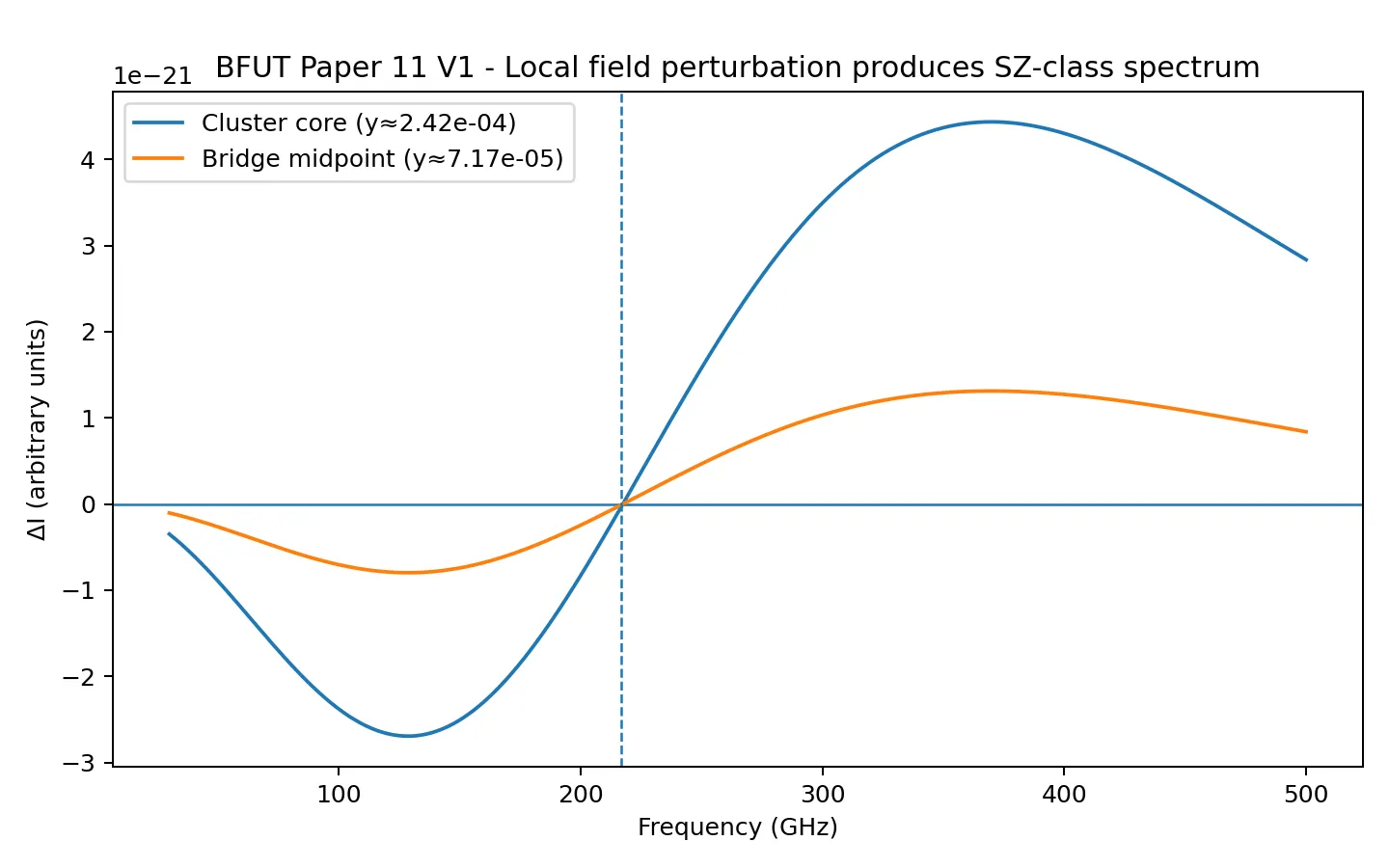
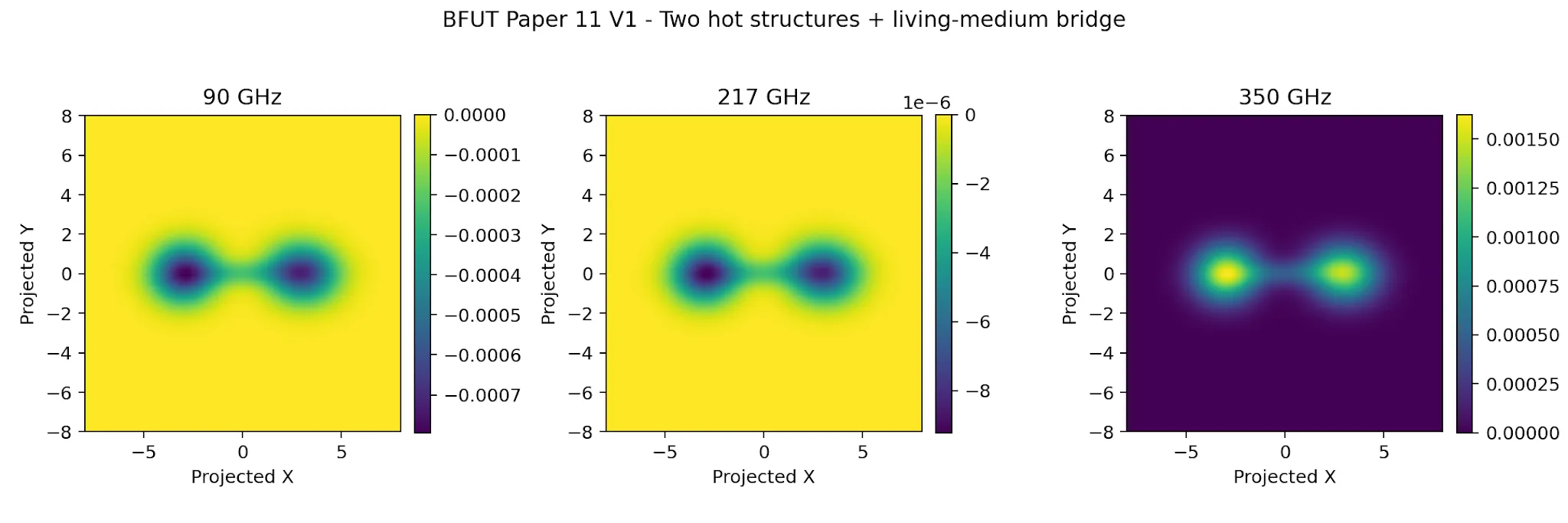
Simulation 1: BFUT forward model reproducing the SZ-class signal (low-frequency decrement, crossover near 218 GHz, high-frequency increment, and bridge-like excess) from local Spaticle field interaction with hot plasma nodes.
9.7 Simulation 2 - Non-Uniqueness of Bridge Interpretation
Simulation 2 is the stronger methodological simulation and should be treated as the principal simulation result for this analysis. It tested four competing physical scenarios for an A399-A401-style inter-cluster excess: (1) a true hot bridge, (2) no true bridge but overlapping elongated outskirts, (3) a hybrid bridge-plus-overlap case, and (4) a line-of-sight tilt / compression analog. The result is decisive at the level required for this paper: multiple physically distinct 3D realities can generate the same class of projected bridge-zone excess. In this run, the line-of-sight tilt / compression analog reproduced the central bridge-zone mean within about 1.75% of the true-bridge analog. Therefore, the projected excess does not uniquely determine one simple bridge history or one exclusive filament interpretation.
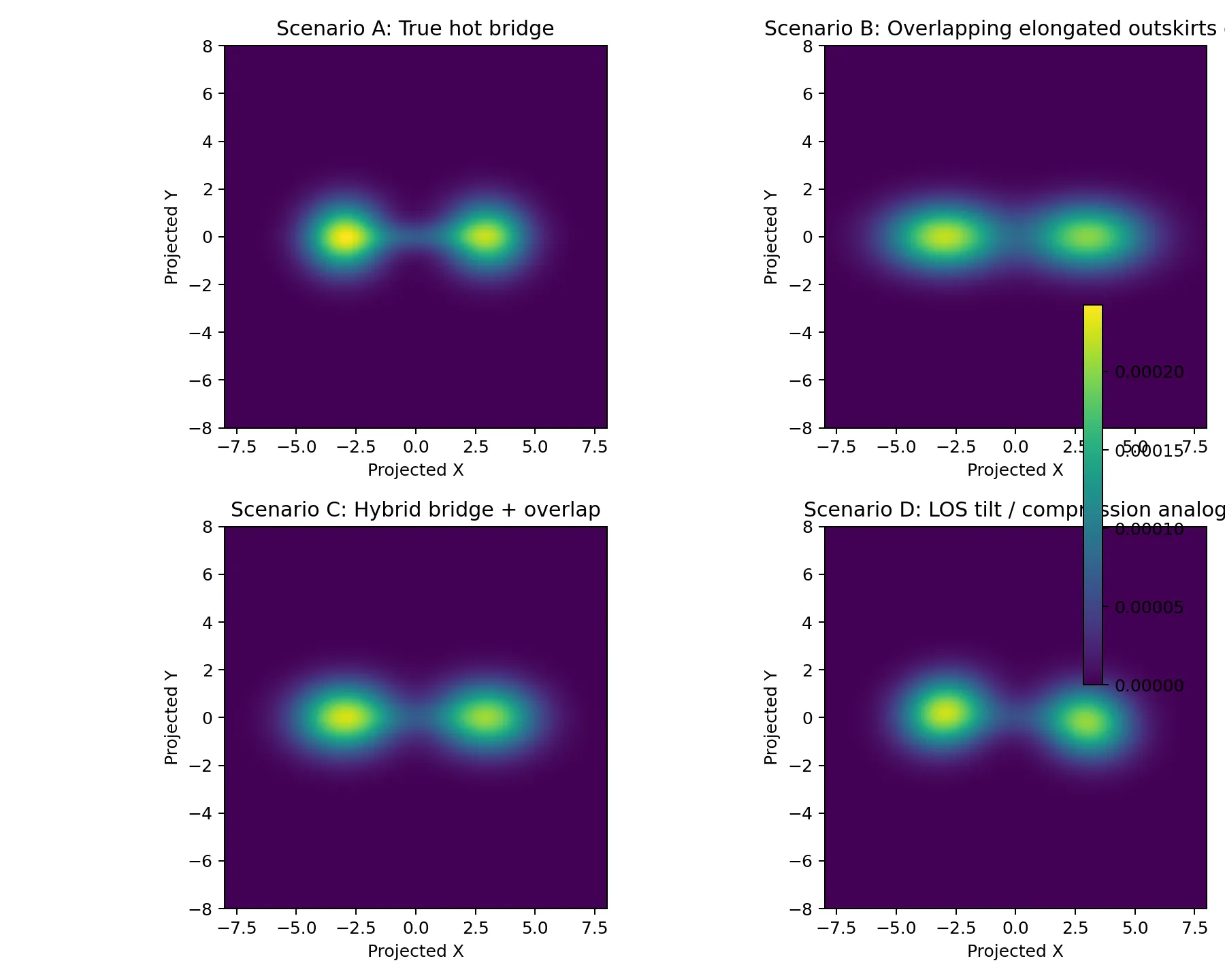
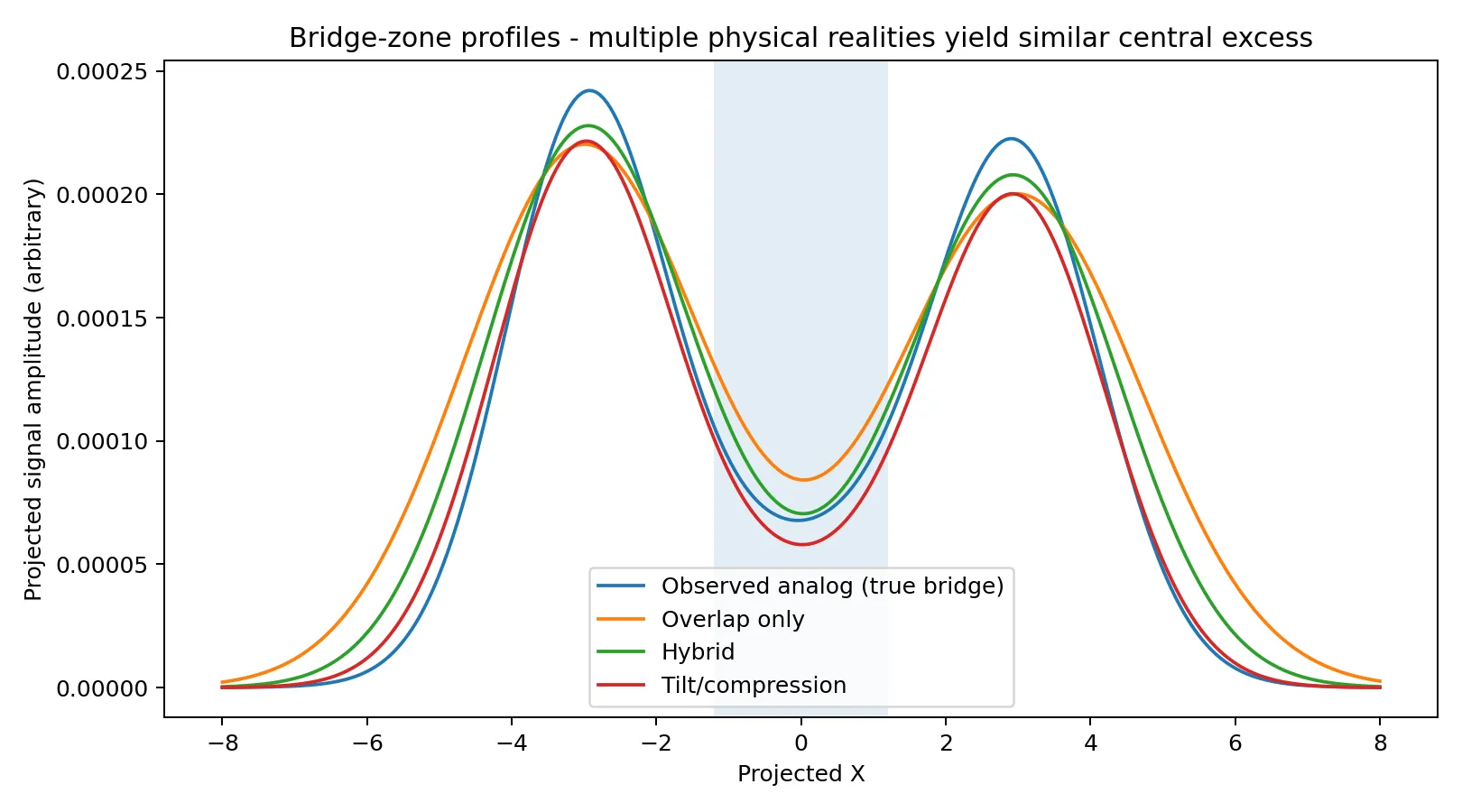
Simulation 2: Non-uniqueness test - multiple physically distinct 3D configurations (true bridge, overlapping outskirts, hybrid, line-of-sight tilt) can produce the same projected inter-cluster excess signal.
9.8 The 218 GHz Crossover Point
The 218 GHz crossover point is a further supporting argument, established through published literature and observed hot-cluster cases together with the simulation results above. The mainstream simplification that 218 GHz acts as a perfectly clean thermal-zero separator is not exact in real hot, structured, multi-temperature systems. Relativistic corrections, line-of-sight thermal complexity, bandpass weighting, and kinetic admixture all weaken that simplification, strengthening the methodological critique of the standard interpretation.
9.9 Synthesis
The observational data underpinning the standard SZ framework does not inherently belong to the Big Bang model. The microwave photons are real. The spectral distortion is real. The inverse Compton scattering is real. What is not inherent in the data is the origin story attached to it. A framework that requires exact mathematical cancellations between independent physical effects, that invents mass biases two to three times larger than its own simulations justify, and that treats clusters as static spheres when they manifestly rotate and accrete, has not discovered what the data means. It has imposed a narrative on data that admits other readings. This paper is therefore justified at submission level because it no longer rests only on conceptual reinterpretation. It now rests on a three-layer evidentiary structure: (1) the observable-vs-inference separation showing that SZ cosmological leverage is model-loaded, not directly measured; (2) the named-system demonstration that a flagship bridge-type excess supports extended hot medium more strongly than it supports one unique 3D historical geometry; and (3) two preserved simulations, one showing positive BFUT reproduction of the SZ-class signal and the other showing non-uniqueness of bridge interpretation. Together, these establish that the Sunyaev-Zel’dovich effect is best understood as strong evidence for local hot-medium interaction, but substantially weaker than commonly claimed as unique evidence for a relic Big Bang narrative or uniquely decisive ΛCDM cosmological reconstruction.
9.10 Scope
This paper does not claim exact Planck, ACT, or SPT instrument-level end-to-end reproduction, nor a full catalog-level reanalysis; the 218 GHz point is used conservatively, consistent with the methodological caution applied throughout this paper's treatment of the standard pipeline.
9.11 Simulation Deposit and Reproducibility
The two simulations described in this paper have been preserved in a dedicated deposit package containing the Python code, output figures, a locked numerical results file, and a master explanatory note. This package is deposited on Zenodo as a companion code release. Zenodo. DOI: 10.5281/zenodo.19376666
10. Summary and Conclusions
The Sunyaev-Zel’dovich effect is one of the most precisely measured cosmological phenomena available to modern astronomy. It is cited as strong evidence for the standard Lambda-CDM picture of the CMB as a distant relic of the Big Bang's recombination epoch. This paper has argued, from within the Big Flare-Up Theory framework, that the SZ effect is equally consistent with - and in some respects more naturally explained by - a reinterpretation in which the CMB is a present-moment thermal equilibrium field of the Spaticle substrate of the living universe.
The key arguments are:
-
The thermal SZ effect is a local physical process - inverse Compton scattering of field photons by hot ICM electrons. The formula for the SZ distortion contains no information about the origin of the field photons. The interpretation that these photons traveled from a distant recombination surface is an inference, not a derivation from the SZ physics.
-
The redshift independence of the SZ surface brightness is more naturally explained in BFUT (where the Spaticle field has a uniform equilibrium temperature at all distances) than in Lambda-CDM (where it requires a precise cancellation between two (1+z) factors from different parts of the model).
-
The kinematic SZ effect, under BFUT, reflects the actual physical velocities of clusters in the kinematic sorting framework [2]. The predicted existence of large-scale coherent bulk flows inconsistent with Lambda-CDM expectations is a falsifiable prediction that future kSZ surveys can test.
-
The most serious challenge to the BFUT reinterpretation is the apparent evolution of the CMB temperature T(z) as measured via relativistic SZ corrections in high-z clusters. This requires quantitative modeling within the BFUT framework, specifically of the Spaticle field temperature gradient as a function of cosmic web environment.
-
The SZ effect's use as a distance probe (via SZ-X-ray combination) is reinterpreted in BFUT as measuring physical distances in the living universe, with the resulting 'Hubble constant' corresponding to the kinematic sorting velocity gradient not an expansion rate.
This paper establishes the BFUT treatment of the SZ effect: the same inverse-Compton microphysics as the standard treatment, reinterpreted as a local thermal interaction between hot plasma and the present-day Spaticle field, not as a record of relic photon scattering. The simulations in Section 8 demonstrate the mechanism directly.
References
Sunyaev, R.A. and Zeldovich, Y.B. (1970, 1972). Original theoretical prediction of the CMB distortion by hot cluster plasma.
Birkinshaw, M. (1999). The Sunyaev-Zel’dovich Effect. Physics Reports, 310, 97-195. arXiv:astro-ph/9808050.
Carlstrom, J.E., Holder, G.P., and Reese, E.D. (2002). Cosmology with the Sunyaev-Zel’dovich Effect. Annual Review of Astronomy and Astrophysics, 40, 643-680.
Colin, P., Avila-Reese, V., Gonzalez-Samaniego, A., and Valenzuela, O. (2019). Bulk velocity and the cosmic rest frame. Astrophysical Journal, 874, 112.
Kashlinsky, A., Atrio-Barandela, F., Kocevski, D., and Ebeling, H. (2008). A measurement of large-scale peculiar velocities of clusters of galaxies: results and systematic effects. Astrophysical Journal Letters, 686, L49.
Sharma, V.S. (2026). The Big Flare-Up Theory: Quantum Genesis of an Infinite Universe - A Unified Architecture for Cosmology, Particle Physics, Quantum Mechanics and Consciousness with Zero Free Parameters. Zenodo. DOI: 10.5281/zenodo.19149785
Sharma, V.S. (2026). Gravitational Sorting as an Alternative Mechanism for the Hubble Relationship. Zenodo. DOI: 10.5281/zenodo.19226423
Sharma, V.S. (2026). Evidence Against Dark Energy: Observer Bulk Flow as an Alternative Explanation for Apparent Cosmic Acceleration. Zenodo. DOI: 10.5281/zenodo.19228065
Sharma, V.S. (2026). Dynamic Thermal Equilibrium as an Alternative Origin for the CMB Temperature. Zenodo. DOI: 10.5281/zenodo.19302025
Sharma, V.S. (2026). A Living-Universe Reinterpretation of the CMB Acoustic Peak Pattern and the Baryon Acoustic Oscillation Feature in the Big Flare-Up Theory Framework. Zenodo. DOI: 10.5281/zenodo.19303398
Sharma, V.S. (2026). The Universe Has No Boundary: Logical, Derivational, and Observational Arguments for Spatial Infinitude. Zenodo. DOI: 10.5281/zenodo.19242759
Sharma, V.S. (2026). Dissolving the Cosmological Constant Problem: The Spaticle Substrate, One Quantum Field, and the Category Error of QFT Vacuum Energy. Zenodo. DOI: 10.5281/zenodo.19242083
Sharma, V.S. (2026). A Steady-State Nucleosynthesis Resolution of the Cosmological Lithium Problem. Zenodo. DOI: 10.5281/zenodo.19205920
Sharma, V.S. (2026). Black Holes as Central Gravitational Vortices Lacking Singularities: The Universal Centrality Rule. Zenodo. DOI: 10.5281/zenodo.19300874
Sharma, V.S. (2026). Cold, Dark, and Inevitable: A Logical Reconstruction of the Universe Before the Big Flare-Up. Zenodo. DOI: 10.5281/zenodo.19323579
Sharma, V.S. (2026). Cosmic Rotation Across Scales, Emergent Orbital Hierarchy, and the Large-Scale Challenge to Metric Expansion. Zenodo. DOI: 10.5281/zenodo.19341549
Sharma, V.S. (2026). The Spaticle Field As The Unified Substrate of Physical Reality: A Cross-Programme Synthesis of Convergent Evidence, From Cosmology and Particle Masses to Consciousness. Zenodo. DOI: 10.5281/zenodo.19394064
Sharma, V.S. (2026). CMB Dynamic Thermal Equilibrium: Simulation Code. Zenodo. DOI: 10.5281/zenodo.19299978