
BFUT P11
The Lyman-Alpha Forest in the Big Flare-Up Theory: Absorption Percolation Threshold and Interpretive Non-Uniqueness of the Gunn-Peterson Opacity Rise
Abstract
The Lyman-alpha forest is one of the most powerful observational tools in modern cosmology, used to infer the distribution of intergalactic hydrogen, trace the large-scale structure of the cosmic web, and reconstruct the ionization history of the universe. The standard model treats the sharp rise in high-redshift Lyman-alpha opacity - the Gunn-Peterson effect - as the direct observational signature of a unique global reionization boundary: the epoch at which the intergalactic medium transitioned from neutral to ionized. This paper accepts the observational reality of the forest and the high-z opacity rise but disputes the uniqueness of that historical interpretation.
The central argument is that the observed quantity is a rapid increase in Lyman-alpha opacity along selected sightlines, not a directly observed global reionization boundary. The latter is an interpretive inversion that depends on absorber ontology, radiative-transfer assumptions, continuum reconstruction, and prior cosmological framing. Within the Big Flare-Up Theory (BFUT), a smooth increase in line-of-sight absorber encounter rate, characteristic depth, and effective coverage naturally produces a sharply nonlinear collapse in transmitted flux once an Absorption Percolation Threshold (APT) is crossed - without invoking metric expansion, a privileged early epoch, or a unique cosmic phase transition.
The strongest standard interpretation treats the Gunn-Peterson opacity rise as a historical boundary; the present work shows that the same observational class can arise as a present-epoch overlap threshold in a structured absorber field. Five proof-of-concept
simulations support this framework. The APT main simulation demonstrates flux declining from
1.000 at low redshift to 0.042 at high redshift, with both F < 0.20 and F < 0.10 thresholds crossed within the same transition bin centered near z ~ 6.35, and maximum optical-depth steepening at z ~ 6.65. The APT environment-shift simulation demonstrates that modest absorber density changes shift the apparent onset redshift across a span of approximately 0.9 in z, consistent with environment-sensitive threshold behavior, not a fixed global epoch boundary. Three further simulations demonstrate that forest-like absorption hierarchies, strong trough-like suppression, and damping-wing-like red-side attenuation are all non-unique with
respect to underlying absorber architecture. The relevant issue is not the line-by-line reconstruction of any single spectrum, but the reproducibility of the principal observational classes: forest-like line ensembles, trough-like high-opacity regimes, and damping-wing-like red-side attenuation. The Lyman-alpha forest therefore remains fully real as observation. Its strongest standard-model historical reading is less exclusive than commonly claimed.
Keywords: Lyman-alpha forest, Gunn-Peterson opacity, absorption percolation threshold, reionization, Spaticle field, intergalactic medium
Author's Note on Framework Context
This paper is part of the Big Flare-Up Theory (BFUT) companion paper series. The BFUT proposes a living, infinite, non-expanding universe in which cosmological redshift is the product of gravitational kinematic sorting, not metric expansion of space. The framework has been developed and published across a main paper [8] and companion papers addressing the Hubble relationship [9], the cosmological constant [10], the lithium problem [11], apparent cosmic acceleration [12], spatial infinitude [13], black holes [14], CMB temperature [15], CMB acoustic peaks [16], the
pre-flare-up state of the universe [17], large-scale orbital hierarchy [18], the physical nature of the Spaticle substrate of spacetime [19], and the Sunyaev-Zel'dovich effect [20]. The present paper addresses the Lyman-alpha forest and high-redshift Gunn-Peterson opacity rise.
The reader is directed to the main BFUT paper (DOI: 10.5281/zenodo.19149785) for the foundational arguments underlying the framework. The core argument of each companion paper is stated directly where relevant so this paper stands on its own merits.
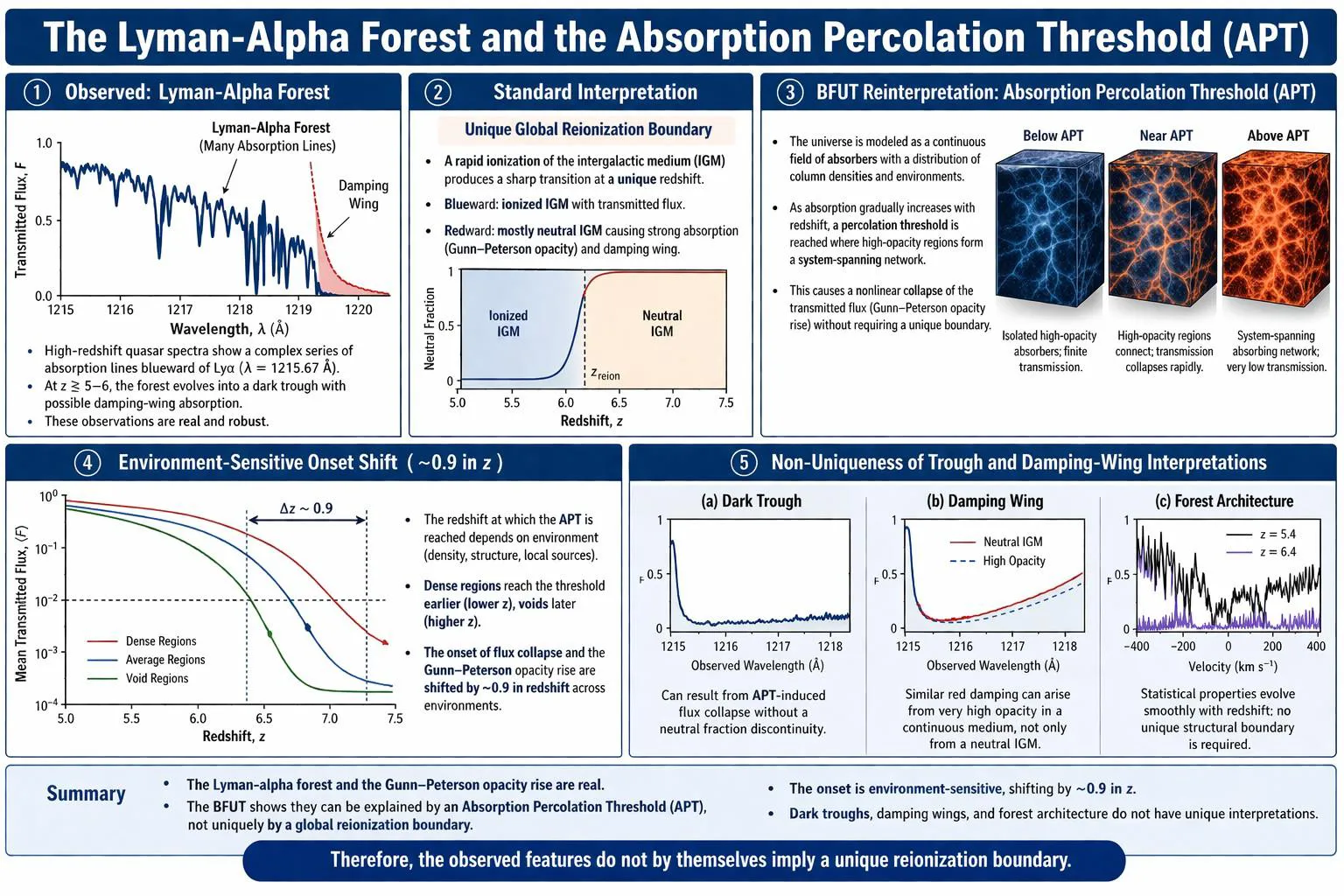
Infographic. Conceptual summary of the BFUT reinterpretation of the Lyman-alpha forest: the observed Gunn-Peterson opacity rise is treated as an Absorption Percolation Threshold (APT) and an environment-sensitive, non-unique absorption transition, not a uniquely inferred global reionization boundary.
Introduction
High-redshift quasars function as cosmic backlights, allowing the intervening absorber field to be inferred from the transmitted spectrum. The Lyman-alpha forest consists of numerous distinct absorption features appearing blueward of the intrinsic Lyman-alpha emission line in quasar spectra. Each feature corresponds to a cloud of neutral hydrogen absorbing photons at the Lyman-alpha wavelength. In the standard model, the wavelength displacement of each feature from line center is interpreted as the cosmological redshift of the absorbing gas, and the ensemble of features is treated as a tomographic record of the evolving intergalactic medium along a line of sight through an expanding universe.
At redshifts above approximately 6, the forest transitions into the Gunn-Peterson trough [1,2]: a regime of near-complete absorption where transmitted flux effectively vanishes over extended wavelength intervals. This transition is interpreted by the standard model as the boundary of cosmic reionization [6,7] - the epoch at which the intergalactic medium passed from predominantly neutral to predominantly ionized. The abruptness of this onset, combined with its occurrence across multiple quasar sightlines in a limited redshift range, has been taken as strong evidence that a unique global cosmic-time boundary has been directly observed.
The Big Flare-Up Theory accepts the observation. It disputes the uniqueness of the interpretation.
A spectrum ordered in nominal redshift is not, by itself, a spectrum ordered in cosmic age. The conversion of redshift ordering into a universal historical sequence is contingent on the cosmological model adopted, not a property read directly from the absorption data alone. That distinction is the foundation of this paper. The observed quantity is a rapid increase in
Lyman-alpha opacity along selected high-redshift sightlines. The stronger statement - that this marks a unique global cosmic-time transition in the ionization state of the universe - is a second-stage interpretive inversion that depends on absorber ontology, radiative-transfer assumptions, continuum reconstruction, and prior cosmological framing. This paper demonstrates that a present-universe threshold mechanism produces the same observational class of signal without requiring any of that historical machinery.
What Is Actually Observed, and What Is Inferred
The methodological core of this paper is a distinction that is often collapsed in the standard literature: what the spectra directly establish, and what is concluded from them after additional model assumptions are imposed.
What the spectra directly establish:
Strong Lyman-alpha absorption is present along the line of sight. Transmitted flux declines as a function of increasing nominal redshift. Dark-gap or trough-like segments appear at high redshift. Near-zone lengths can be measured phenomenologically around luminous sources.
Red-side suppression relative to an assumed intrinsic emission profile can be measured.
What is not directly measured from the spectrum alone:
The global neutral fraction of the diffuse intergalactic medium. A unique reionization completion redshift. A unique reionization timeline or topology. A unique diffuse-neutral interpretation of
damping-wing-like suppression. A unique universal historical boundary inferred from a small number of sightlines.
The spectrum directly constrains absorption and transmitted flux, but the conversion of those observables into a unique global neutral fraction or a unique reionization chronology requires additional model assumptions that are not themselves measured by the spectrum. This is not a criticism of the observations. It is a statement about the inferential distance between the raw spectral data and the historical conclusions routinely attributed to them.
The present work therefore addresses the reproducibility and non-uniqueness of the relevant observational classes - forest-like line ensembles, trough-like suppression, onset-like opacity transitions, and damping-wing-like red-side attenuation - without claiming a line-by-line reproduction of any individual high-redshift quasar spectrum.
The Standard Model's Reionization Reading and Its Assumptions
The Gunn-Peterson Effect
The Gunn-Peterson effect is the near-complete absorption of quasar flux blueward of the Lyman-alpha emission line when the line of sight passes through a sufficiently neutral intergalactic medium. Gunn and Peterson first predicted this effect in 1965 [1]; its unambiguous detection was announced by Becker et al. [2] in quasars at z > 6, using data from the Sloan Digital Sky Survey [3]. The effective optical depth to Lyman-alpha absorption was found to rise steeply above z ~ 6, with some sightlines showing complete flux suppression over extended wavelength intervals.
The Standard Reionization Inference
Lambda-CDM interprets this observation as direct evidence that the universe's intergalactic medium was predominantly neutral at z > 6 and became predominantly ionized by z ~ 6 through the radiation of the first luminous sources. This reionization epoch is treated as a unique global event: a universal phase transition in the ionization state of cosmic hydrogen, observable in principle from any sightline to sufficiently high-redshift quasars.
The inference chain from observation to conclusion runs as follows. Near-complete
Lyman-alpha absorption requires a high neutral fraction along the line of sight. A high neutral fraction at z > 6 and low neutral fraction at z < 6 implies a transition occurred in that redshift interval. The transition is identified with the completion of reionization. Because the
Lyman-alpha cross-section is large, even a neutral fraction of order 10^-4 produces optical depth of order unity, making the forest a sensitive probe of the neutral fraction. Conversely, the near-complete Gunn-Peterson troughs at z > 6 imply neutral fractions of order 10⁻³ or higher.
The Hidden Assumptions
Each step in this inference chain carries assumptions that are not themselves measured by the spectrum. The conversion from optical depth to neutral fraction assumes a model for the density distribution, temperature, and velocity structure of the absorbing gas. The identification of a universal transition epoch assumes that the behavior observed along a handful of exceptional sightlines - luminous quasars at z > 6, which are rare and likely inhabit atypical environments - is representative of the global intergalactic medium. The assignment of that transition to a
specific cosmological time assumes that redshift uniquely encodes cosmic age, not kinematic organization.
The present paper challenges the uniqueness of the last assumption while accepting the first two as working descriptions of local absorber physics. The relevant question is not whether neutral hydrogen produces Lyman-alpha absorption - it does - but whether the observed sharp transition in opacity uniquely requires a global reionization boundary at a specific cosmic time.
The BFUT Framework and the Lyman-Alpha Forest
Redshift as Kinematic Organization
Within the BFUT framework, cosmological redshift arises from gravitational kinematic sorting in an infinite, non-expanding universe, not from metric expansion of space. The Gravitational Sorting paper established that a Hubble-like linear relation between recession velocity and distance emerges naturally from present-universe kinematic organization, with H0 = 1/T where T = 14.6 Gyr yields the Planck-era value without any expansion machinery.
In this framework, the redshift ordering of the Lyman-alpha forest does not require an expanding coordinate system. A quasar sightline passes through structured kinematic domains - filaments, nodes, voids, and orbital-hierarchy regions of the living cosmic web - each with characteristic gas densities, velocity dispersions, and neutral fractions determined by local physics, not by position along a universal temporal axis. The forest is a map in velocity space, not a mandatory timeline in cosmological age.
Neutral Hydrogen in a Living Universe
One of the hidden assumptions in the standard use of the forest is that widespread neutral hydrogen at high redshift is a remnant of an earlier, more gas-rich universe. In an infinite-age living universe, this assumption is unnecessary. Neutral hydrogen is continuously recycled through stellar mass loss, supernova ejecta cooling, galactic fountains and outflows, circumgalactic condensation, filament cooling, shock compression followed by recombination, and ongoing matter cycling within the Spaticle substrate. The presence of widespread absorbers at high apparent redshift does not uniquely require a one-time primordial gas phase.
Why Abruptness Does Not Imply a Phase Boundary
A sharply nonlinear change in an observed quantity does not, by itself, prove a sharply nonlinear change in global cosmic history. In line-of-sight absorption problems, a smooth change in absorber abundance, overlap, clustering, or effective covering can generate a steep transition in transmitted flux once overlap becomes sufficiently strong. The apparent abruptness of the opacity rise can be a geometric consequence of line-of-sight overlap, not direct evidence of a global phase transition. Accordingly, the apparent abruptness of the high-redshift Lyman-alpha opacity rise should not be treated as direct evidence for a unique cosmic-time phase boundary unless competing threshold-based present-epoch explanations have first been excluded.
The central scientific question is therefore not whether high-redshift Lyman-alpha absorption exists, but whether the observed spectral classes uniquely force the standard historical interpretation, or whether comparable classes can arise naturally in a present-epoch_vss
framework through structured absorber fields, overlap thresholds, and non-unique absorber architectures. The simulations in Sections 7 through 11 address this question directly.
The Proximity Effect as a BFUT Strength
The proximity effect - the thinning of the Lyman-alpha forest near the background quasar due to the quasar's own ionizing radiation - is fully accepted in BFUT and becomes a conceptual strength, not a complication. The forest visibly responds to present local conditions. It is not merely a frozen fossil record of a primordial ionization history. It is the absorption signature of a living, active medium that responds dynamically to its local radiation environment.
Near-zone evolution tracks the quasar's ionizing luminosity and the local absorber density. Near-zone measurements are phenomenologically valuable, but they are not self-interpreting: the observed extent of transmitted flux near a luminous source depends not only on the surrounding absorber field but also on source luminosity, source age, anisotropy, local
environment, line blending, and continuum reconstruction. Near-zone evolution should therefore be treated as a model-sensitive diagnostic, not as a direct stand-alone measurement of a unique global reionization stage.
The Absorption Percolation Threshold: The Central Mechanism
The central mechanism of this paper is the Absorption Percolation Threshold (APT). It is conceptually distinct from a cosmic reionization boundary and provides a present-universe explanation for the sharp high-redshift opacity rise.
In a line-of-sight absorption system, the relevant quantity is not merely the number of absorbers but the effective covering fraction of their optical depth profiles in velocity space. Let lambda denote the absorber encounter rate per unit velocity interval and w the effective absorption width of a typical system after thermal broadening, instrumental response, and local clustering. The product C = lambda x w acts as an effective covering factor in velocity space. When C is much less than unity, absorbers are mostly isolated and the spectrum shows a conventional forest of discrete lines. As C approaches order unity, overlap becomes increasingly common. Once the system crosses the Absorption Percolation Threshold, the overlap of saturated or partially saturated absorbers causes transmitted flux to collapse nonlinearly, producing an extended
near-trough regime even if the underlying increase in absorber density is smooth.
This mechanism is conceptually distinct from a cosmic reionization boundary. The APT mechanism is a line-of-sight overlap threshold in velocity space. It does not require a discontinuity in underlying absorber abundance or a privileged cosmological epoch. APT is not a statement about the universe suddenly changing epoch. It is a statement about line-of-sight coverage in an already existing, structured absorber field. In the BFUT framework, this is a natural present-universe mechanism. As one observes increasingly distant or higher-velocity sightlines through the living cosmic web, the absorber encounter rate, characteristic width, and clustering probability may increase gradually due to the density structure of the cosmic web accessed at larger velocity separations. The resulting collapse in transmitted flux can therefore appear abrupt even though no privileged cosmological time boundary has been crossed.
In the APT framework, the transition occurs when overlapping absorbers progressively eliminate persistent transmission gaps in velocity space, causing transmitted flux to collapse nonlinearly. The importance of this distinction is methodological. The standard model treats the high-z
opacity rise as if it directly reveals the timing of a global historical transition. BFUT argues that the raw observation is only the collapse of transmitted flux. Whether that collapse should be read as a unique reionization boundary or as a threshold in absorber overlap is a matter of physical interpretation. The APT mechanism demonstrates that the latter is a viable
present-universe alternative.
Observable Evidence Versus Inferred Cosmology
|
Directly observed from spectrum |
Inferred after additional assumptions |
|---|---|
|
Flux decrement at specific wavelengths |
Global neutral fraction of diffuse IGM |
|
Effective optical depth along sightline |
Unique reionization completion redshift |
|
Near-zero transmission in trough segments |
Universal cosmic phase transition epoch |
|
Red-side flux suppression near emission line |
Unique diffuse-neutral IGM interpretation |
|
Near-zone transmitted flux extent |
Direct measurement of global reionization stage |
|
Sightline-to-sightline opacity variance |
Unique spatial topology of reionization front |
Because the highest-redshift Lyman-alpha constraints are derived from a limited number of exceptional sightlines, any conversion from observed suppression to a unique global reionization chronology inherits an unavoidable line-of-sight representativeness problem. Strong suppression along a small number of luminous quasar sightlines does not, by itself, prove that a single universal historical boundary has been directly observed. Luminous quasars at z > 6 are rare objects that almost certainly inhabit atypical overdense environments; the absorber properties along their sightlines may not be representative of the global intergalactic medium.
The central interpretive issue is not the reality of the absorption, which is unquestioned, but the uniqueness of the historical inversion. High-redshift Lyman-alpha spectra directly show absorption and flux suppression. They do not directly display a global cosmic-time boundary.
The high-redshift Lyman-alpha data directly establish a sharp increase in line-of-sight opacity and, in some cases, extended near-zero transmission segments. They do not directly display a global cosmic-time boundary. The standard interpretation of these observables as a unique reionization epoch is an additional historical inference imposed on the spectrum, not a quantity read directly from it. The step from observed suppression to a unique reionization chronology, a unique neutral-fraction history, or a unique diffuse-neutral intergalactic medium requires model assumptions about continuum placement, absorber decomposition, radiative transfer, source environment, and cosmological priors. The present work therefore addresses not whether the absorption is real, but whether the standard historical interpretation is uniquely compelled by the data.
Proof-of-Concept Simulation of the Absorption Percolation Threshold
To test whether a present-universe threshold in absorber overlap can generate a
Gunn-Peterson-like opacity rise, a proof-of-concept synthetic sightline was constructed without invoking metric expansion, a cosmological phase transition, or any imposed reionization redshift. A nominal redshift-like coordinate from z = 4.5 to z = 7.0 was used purely as an ordering proxy along the line of sight. Along this proxy coordinate, the absorber encounter rate, characteristic depth, and characteristic width were allowed to increase smoothly as power-law functions of position. No discontinuity was inserted anywhere in the model.
The simulation placed 200 absorber components with centers biased toward the high-z end of the sightline using a power-law distribution. Each absorber was assigned a Gaussian optical depth profile whose peak depth and width scaled smoothly with position. The resulting optical depth field was convolved with a mild smoothing kernel representing instrumental response, and the transmitted flux was computed as F = exp(-tau).
Key numerical results (seed 1201):
|
Quantity |
Value |
|---|---|
|
Low-z bin mean flux (z ~ 4.55) |
1.000 |
|
High-z bin mean flux (z ~ 6.95) |
0.042 |
|
Both F < 0.20 and F < 0.10 thresholds |
Crossed within same transition bin near z ~ 6.35 |
|
Maximum d(tau_eff)/dz |
15.3 per unit redshift at z ~ 6.65 |
|
Analytic covering-factor proxy at transition |
C ~ 11.8 near maximum steepening bin |
The analytic covering-factor proxy C = lambda x w_eff was computed from parametric formulas representing absorber encounter rate and characteristic width. It is an estimate, not a quantity directly measured from the simulated absorbers. The covering-factor value near the transition maximum refers to C evaluated at the bin of maximum optical-depth steepening, not at the first threshold-crossing bin.
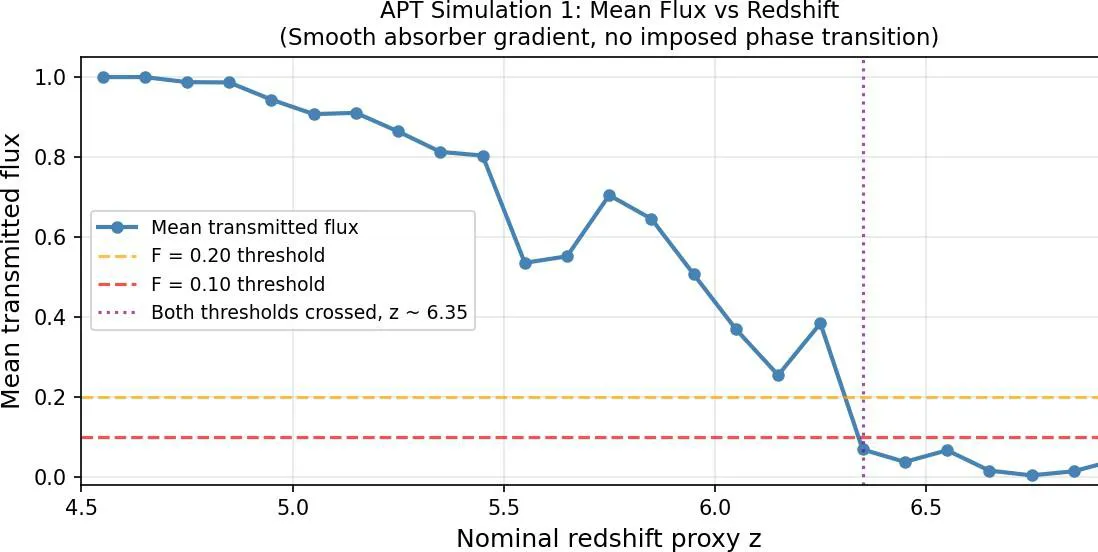
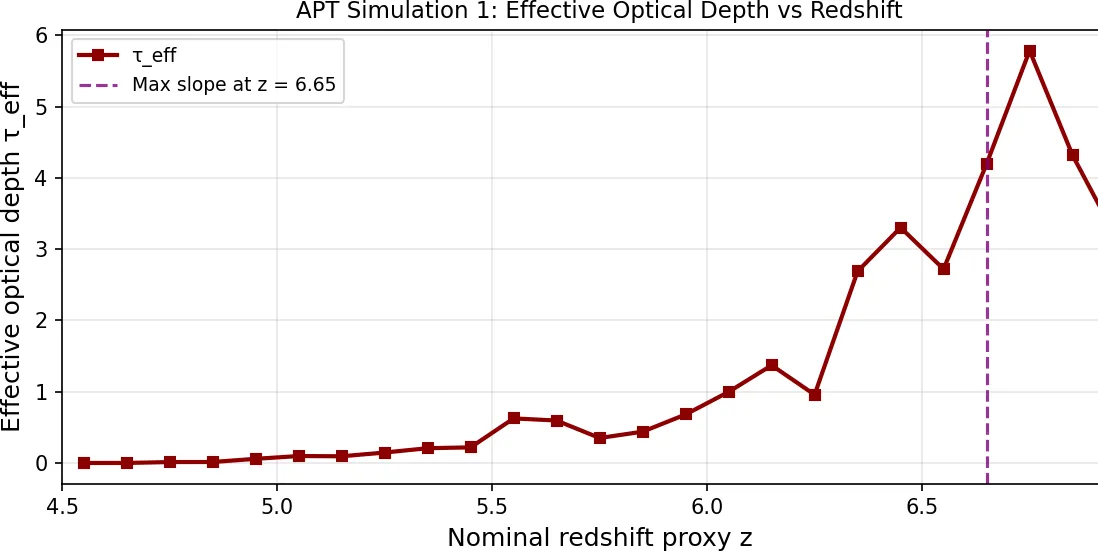
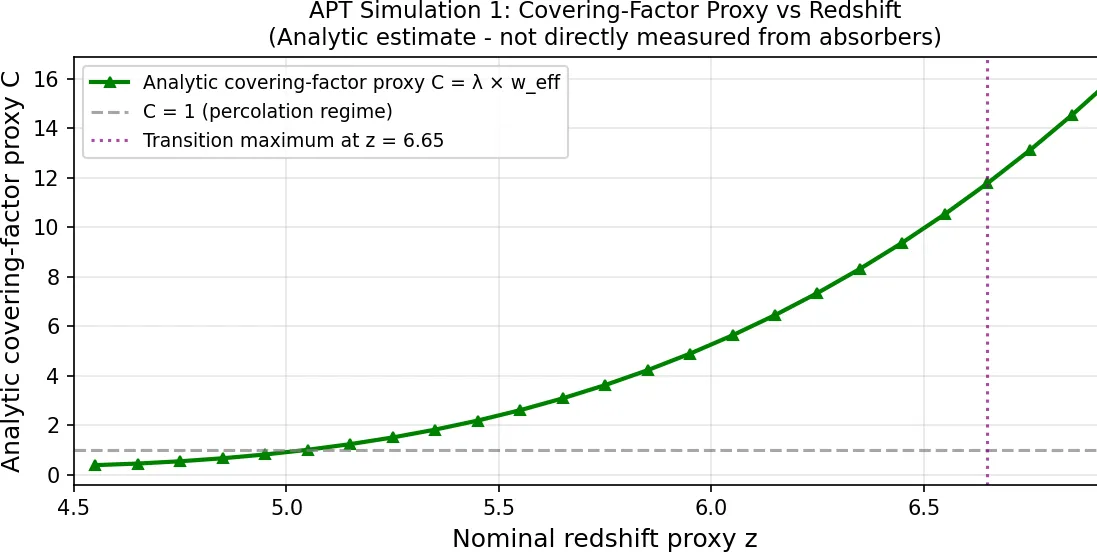
The central result is that a smooth absorber gradient, with no imposed epoch boundary, produces a sharply localized collapse in transmitted flux in the redshift neighborhood z ~ 6.3 to
6.7 - the same neighborhood as the canonical Gunn-Peterson onset. The transition is not caused by a global change in the universe's ionization state. It is caused by the nonlinear consequences of increasing absorber overlap as the effective velocity-space covering factor rises through and beyond order unity. This is the Absorption Percolation Threshold mechanism.
The simulation code, output figures, and locked numerical results are deposited at DOI: 10.5281/zenodo.19378026 [21].
Environment Dependence of the Apparent Onset Redshift
If the Gunn-Peterson-like opacity rise is produced by an Absorption Percolation Threshold, not by a unique global epoch boundary, the apparent onset redshift should depend on line-of-sight environment. To test this, the same proof-of-concept model was re-run across three environmental realizations using scaled absorber counts and scaled absorber depths corresponding to underdense, baseline, and overdense sightlines.
Results (seed 2202):
|
Environment |
Scale |
N absorbers |
F < 0.20 at z = |
F < 0.10 at z = |
|---|---|---|---|---|
|
Underdense |
0.78x |
136 |
6.85 |
6.95 |
|
Baseline |
1.00x |
175 |
6.25 |
6.55 |
|
Overdense |
1.25x |
219 |
6.05 |
6.35 |
The apparent onset redshift spans approximately 0.9 in z across the three environments, arising solely from modest changes in absorber density with no change to the underlying mechanism.
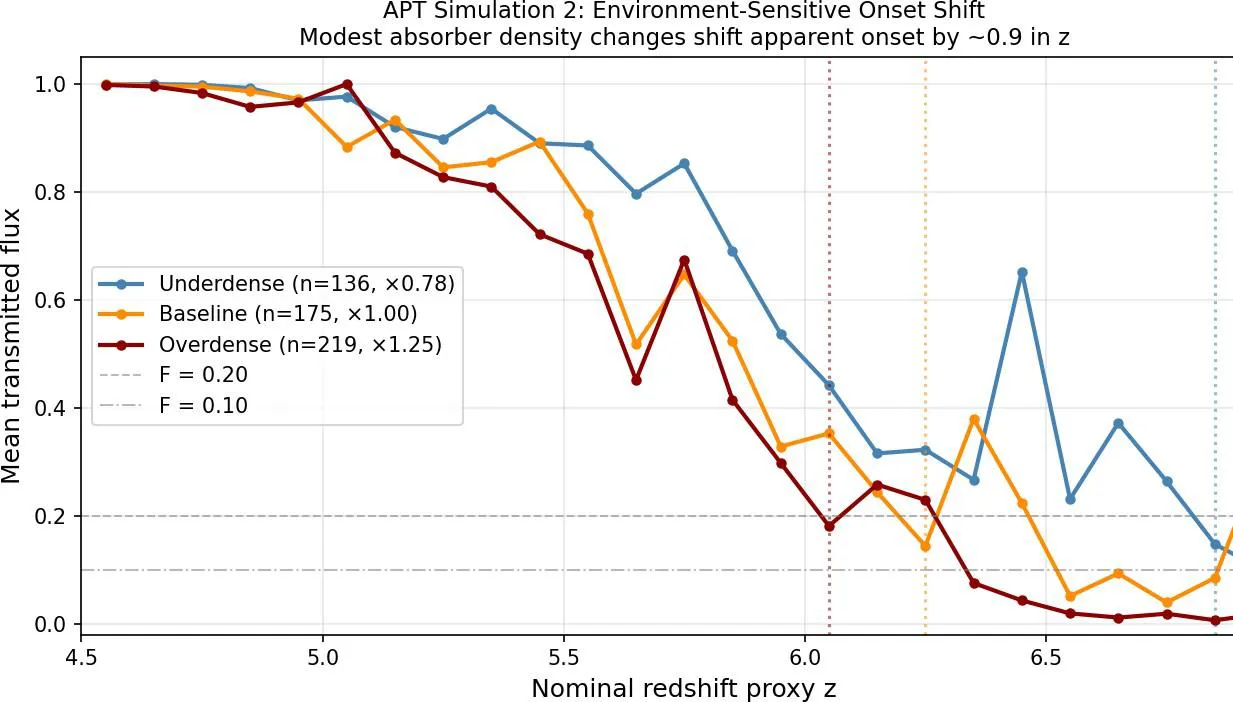
This result has a direct observational implication. Sightline-to-sightline variance in the apparent onset of strong suppression is often modeled in the standard framework as patchy reionization. In the APT framework, the same observational class arises naturally from modest line-of-sight environmental differences that shift the overlap threshold without requiring a globally propagating ionization front. The observed variance in Gunn-Peterson opacity levels across different quasar sightlines at similar nominal redshifts - some showing near-complete suppression at z ~ 6.1 while others show significant transmission at comparable redshifts - is commonly attributed to patchy reionization in the standard model. Under the APT mechanism, such sightline variance is a natural consequence of different lines of sight passing through
environments of different absorber density. No special spatial patchiness in a global reionization front is required. The same underlying physics, applied to the structured living cosmic web, generates the observed variance automatically as an environment-sensitive percolation threshold.
The Forest Without Metric Expansion
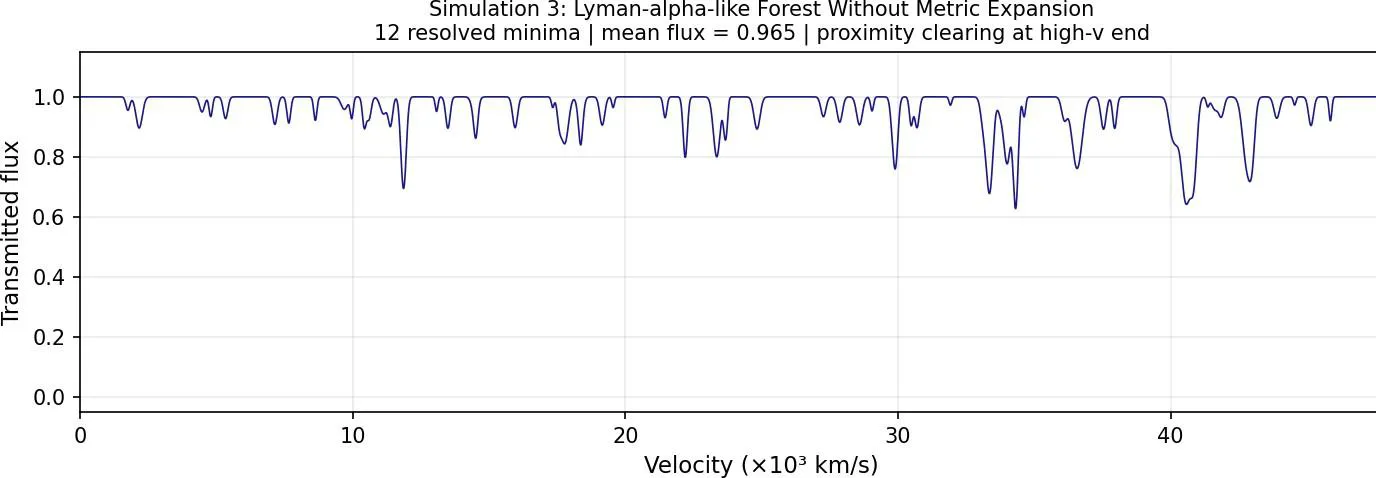
A second proof-of-concept simulation demonstrates that a Lyman-alpha-like absorption hierarchy - a forest of discrete absorption features across a wide velocity range - can be constructed in a non-expanding velocity-structured sightline without invoking cosmological recession or metric expansion.
The simulation defined a velocity axis from 0 to 50,000 km/s, representing the kinematic velocity spread of the observed sightline in the BFUT gravitational-sorting framework. Sixty weak absorbers with thermal-like widths and twelve stronger absorbers were randomly distributed along the sightline. A proximity-effect clearing was applied near the high-velocity end, representing the ionizing influence of the background source.
Results (seed 3303):
|
Quantity |
Value |
|---|---|
|
Absorber components |
72 (60 weak + 12 strong) |
|
Resolved absorption minima |
42 |
|
Mean transmitted flux |
0.965 |
|
Effective optical depth |
0.036 |
|
Mean inter-line spacing |
1,066 km/s |
The resulting synthetic spectrum exhibits a multi-line absorption hierarchy with a range of feature depths, a proximity-effect clearing at the source end, and inter-line spacings consistent with a structured absorber field. The observed quantity is absorption at different velocities. The interpretation of those velocities as cosmological recession distances is an additional inference that the BFUT framework does not require.
Trough Non-Uniqueness
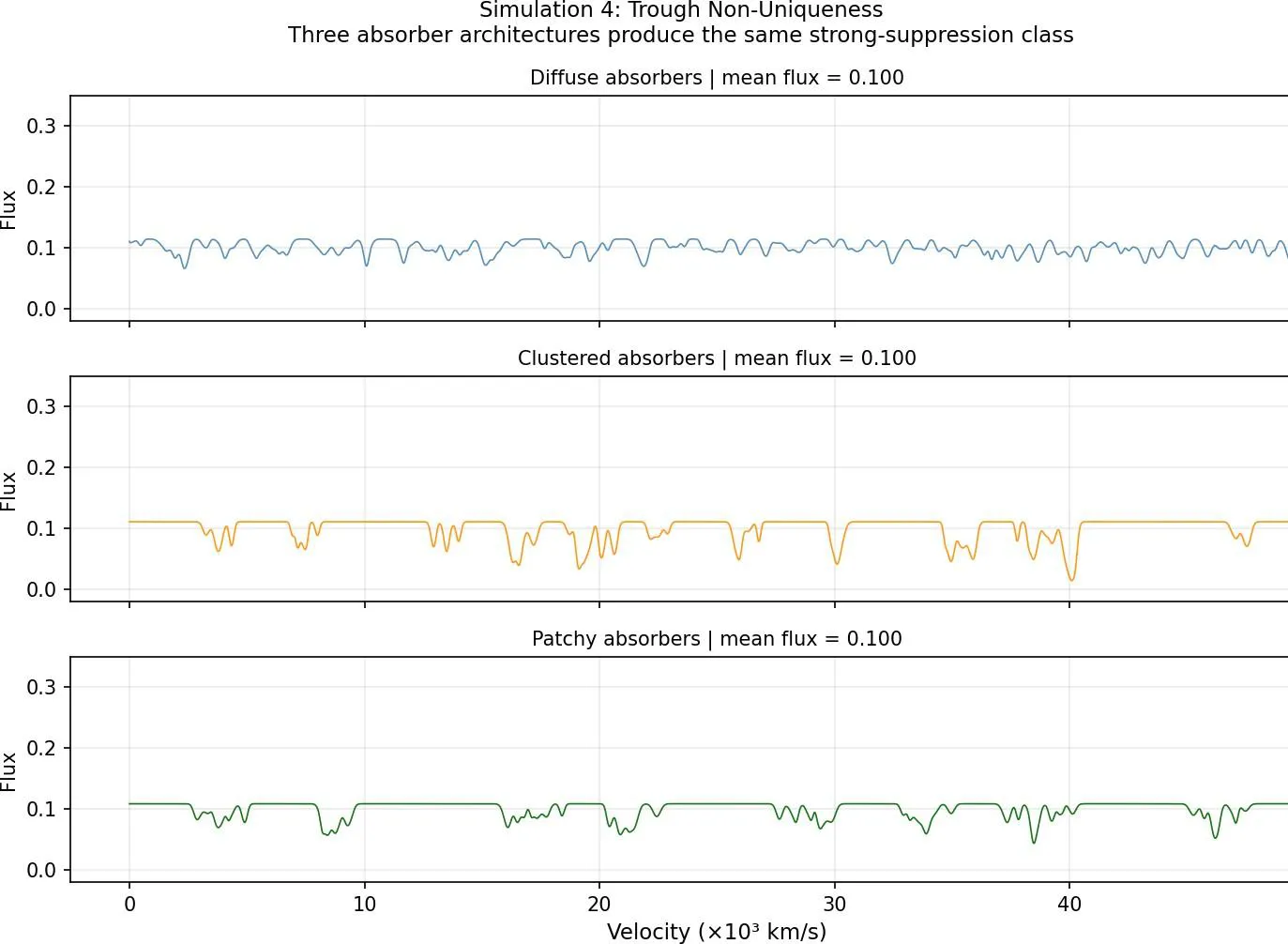
A third simulation addresses the interpretive non-uniqueness of the strong-suppression spectral class. Three physically distinct absorber architectures were constructed and tuned to produce comparable strong suppression, demonstrating that a given dark spectral class does not uniquely determine the underlying physical configuration.
The spectrum constrains the transmitted-flux pattern and integrated optical depth along the line of sight; it does not by itself uniquely determine the absorber ontology responsible for that pattern. Distinct physical architectures can produce observationally comparable suppression classes. A strongly dark or near-trough Lyman-alpha transmission regime is a robust observational class, but it is not uniquely diagnostic of one physical absorber ontology.
Comparable high-opacity states can be generated by diffuse overlap, clustered strong systems, or patchy structured coverage. Therefore, the existence of a dark trough does not, by itself, uniquely determine whether the dominant opacity arises from a diffuse neutral background, clustered discrete systems, or structured mixed environments.
Results (seed 4404):
|
Architecture |
N absorbers |
Mean flux |
tau_eff |
|---|---|---|---|
|
Diffuse (uniform) |
180 |
0.0999 |
2.304 |
|
Clustered (grouped halos) |
89 |
0.0997 |
2.305 |
|
Patchy (structured patches) |
100 |
0.0997 |
2.306 |
All three architectures produce mean transmitted flux and effective optical depth within 0.3% of each other. The defining observational diagnostic is reproduced by three physically distinct configurations. The inference that the observed trough uniquely requires a specific absorber ontology is not supported by the simulation.
Damping-Wing Non-Uniqueness
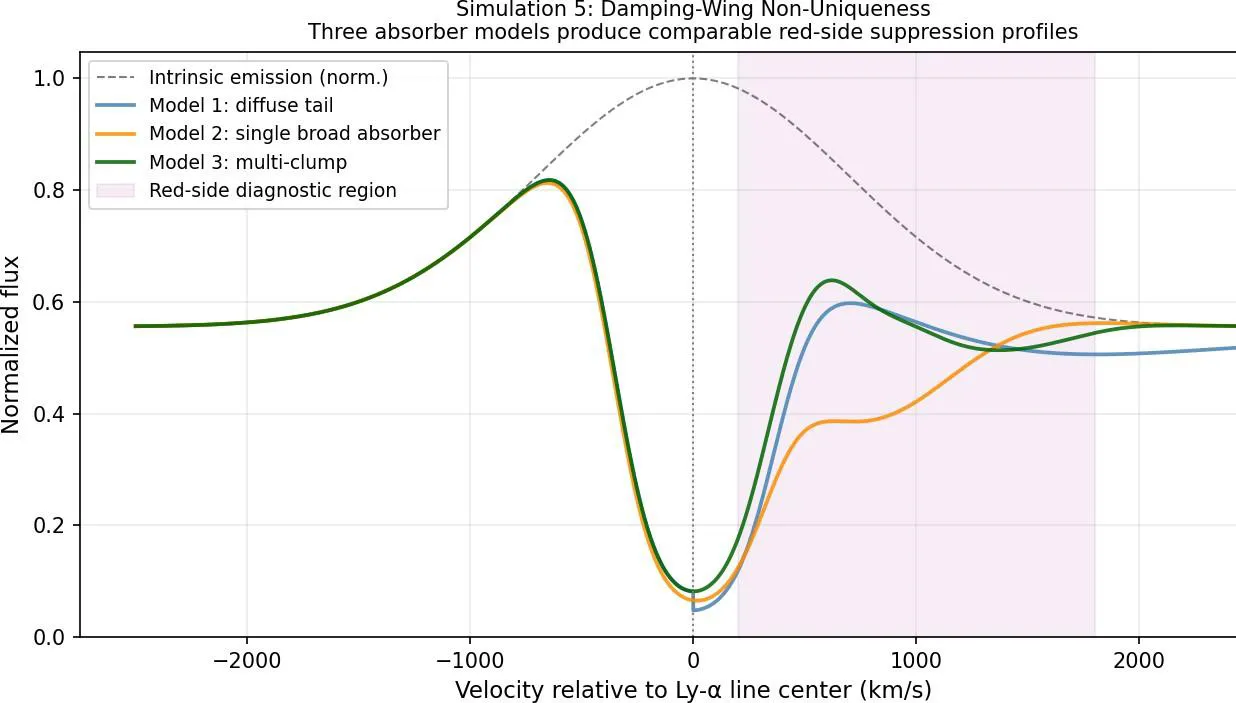
A fourth simulation addresses the interpretive non-uniqueness of damping-wing-like spectral features near the Lyman-alpha emission line of high-redshift quasars. A red-side attenuation profile that resembles a damping wing is not, by itself, a unique identifier of a diffuse neutral intergalactic medium. Similar suppression classes can arise from multiple absorber
architectures, including broader distributed opacity, a strong offset high-column absorber, or multiple blended clumps. The observation is real, but the stronger inference that it uniquely isolates a diffuse-neutral IGM requires exclusion of these alternative spectral constructions.
A damping-wing-like red-side attenuation profile is a real spectral observable, but it is not, by itself, a unique identifier of a diffuse neutral intergalactic medium. Similar suppression classes can arise from broader distributed opacity, a strong offset absorber, or multiple blended components. Three models were constructed: a smooth diffuse neutral-like optical depth tail extending redward from line center; a single offset broad absorber centered approximately 650 km/s redward of line center; and four blended absorber clumps distributed between 420 and 1450 km/s from line center.
Red-side transmission ratio (200-1800 km/s diagnostic region):
|
Model |
Transmission ratio |
Integrated suppression |
|---|---|---|
|
Model 1: diffuse tail |
0.709 |
690 |
|
Model 2: single broad absorber |
0.619 |
905 |
|
Model 3: multi-clump |
0.735 |
626 |
All three models produce comparable red-side suppression while differing substantially in physical configuration and the distribution of suppression across the diagnostic window. This result applies directly to the interpretation of high-redshift quasars such as J1120+0641 [4] and J1342+0928 [5], where damping-wing features have been cited as evidence for a significant neutral hydrogen fraction in the surrounding intergalactic medium at z > 7. More precise constraints on absorber spatial geometry, column density distribution, and velocity structure would be required to distinguish between the physical pictures demonstrated her
Simulation Summary and Collective Interpretation
The five proof-of-concept simulations collectively establish the following. The APT main simulation demonstrates that a smooth increase in absorber density along a line of sight produces an abrupt Gunn-Peterson-like collapse in transmitted flux through the nonlinear percolation mechanism, with no imposed cosmological phase transition. The APT environment-shift simulation demonstrates that the apparent onset redshift of this collapse is environment-sensitive, shifting by approximately 0.9 in z across modest density variations - consistent with the observed sightline variance in real quasar data, and inconsistent with a unique fixed global epoch boundary. The forest simulation demonstrates that a multi-line absorption hierarchy arises naturally in a non-expanding velocity-structured sightline. The trough simulation demonstrates that comparable strong-suppression spectral classes are produced by three physically distinct absorber architectures. The damping-wing simulation demonstrates that comparable red-side suppression profiles near the Lyman-alpha emission line are produced by three physically distinct absorber configurations
Taken together, these simulations establish that every major class of high-redshift absorption feature used by the standard model as evidence for a specific reionization history - the abrupt opacity rise, the Gunn-Peterson trough, and the damping wing - is non-unique with respect to the underlying physical interpretation. The observations are real. The inference that they uniquely require a primordial reionization boundary at a specific cosmic time is not supported by the observations alone.
The simulation code, generated figures, and locked numerical results are deposited at DOI: 10.5281/zenodo.19378026 [21]. All scripts use explicit random seeds for full reproducibility.
The BFUT Reinterpretation: A Positive Statement
Within the BFUT framework, high-redshift Lyman-alpha opacity need not be interpreted as a relic of a unique early-universe ionization transition. It can be understood as a
present-epoch line-of-sight phenomenon in which increasingly complex absorber environments, stronger overlap, and structured coverage naturally generate forest-like absorption, trough-like suppression, and damping-wing-like attenuation without requiring an expanding universe or a privileged cosmological epoch boundary.
Within BFUT, the high-redshift opacity rise is interpreted as an edge of observability produced by absorber overlap, not as a uniquely observed edge in cosmic history. The BFUT picture is as follows. Quasars are luminous backlights embedded in the living cosmic web. Light travels from the quasar through a structured intergalactic medium composed of neutral or partially neutral gas pockets, filaments, and kinematically organized domains. The absorbers occupy different kinematic states relative to the observer, with their velocity displacements reflecting the gravitational sorting and orbital hierarchy of the cosmic web, not recession from a singular origin. The line forest is the integrated absorption signature of this nested velocity structure. At high velocity separations - corresponding to high nominal redshift in the standard reading - the absorber encounter rate increases because sightlines probe progressively denser and more structured regions of the cosmic web. When the effective covering factor crosses the Absorption Percolation Threshold, the forest transitions sharply into a trough-like regime. This is a present-universe phenomenon with no privileged temporal boundary.
This reinterpretation preserves the full observational reality of the forest. The hydrogen is real. The absorption is real. The absorption lines are real. The high-z opacity rise is real. What changes is the cosmological reading. Once redshift is no longer treated as a mandatory metric-distance clock encoding cosmic age, the forest ceases to be a unique proof of an expanding-space reionization timeline and becomes compatible with a non-expanding,
infinite-age, dynamically organized universe.
BFUT Predictions
The BFUT framework makes the following falsifiable predictions regarding the Lyman-alpha forest.
Prediction 1 - Environment-correlated onset variance.
The apparent Gunn-Peterson onset redshift should vary across quasar sightlines in a manner correlated with the large-scale environment of the sightline, not merely with its nominal redshift. Sightlines passing through overdense filament or node regions should show earlier onset; sightlines through voids should show later onset. This prediction follows directly from the APT mechanism and is testable with existing high-z quasar samples.
Prediction 2 - Sightline variance exceeding patchy-reionization models.
The quasar-to-quasar variance in forest opacity at fixed nominal redshift should be larger than patchy-reionization models predict, because the BFUT environment-shift mechanism generates a wider spread in apparent onset than uniform reionization patchiness alone.
Prediction 3 - Proximity zone correlation with present environment.
Near-zone sizes should correlate with present local environment density as well as quasar luminosity, reflecting the living-medium structure of the absorber field, not a global reionization front.
Prediction 4 - No unique preferred onset redshift.
Future surveys with larger high-z quasar samples should find a broad distribution of Gunn-Peterson onset redshifts, not a sharp universal boundary, consistent with an environment-sensitive percolation threshold.
Scope and Limitations
The present paper does not claim that the standard reionization framework has been quantitatively replaced at the catalogue level. Its specific claim is that the principal observational classes used in that framework are not uniquely diagnostic of the standard historical interpretation. The existence of a redshift-ordered absorption forest, a sharp high-z opacity rise, a near-complete Gunn-Peterson trough, and damping-wing-like suppression profiles do not uniquely require metric expansion or a unique global reionization boundary. The proof-of-concept simulations demonstrate non-uniqueness at the level of the relevant observational classes.
This paper does not claim to have replaced the full hydrodynamical machinery of the standard model. It does not reproduce the 1D or 3D flux power spectrum quantitatively, model detailed thermal history, fit line-width distributions, include metal contamination, or perform
catalogue-level Bayesian inference against BOSS, eBOSS, XQ-100, or DESI data. These are reserved for the future quantitative programme.
The simulations are proof-of-concept demonstrations at the class level, not fits to individual quasar spectra. The covering-factor proxy is an analytic estimate, not a direct measurement from simulated absorbers. All scripts use explicit random seeds and are deposited for full reproducibility.
Conclusion
The central result of this paper is that the strongest standard-model historical inference drawn from the high-redshift Lyman-alpha forest - namely that the abrupt opacity rise marks a unique global reionization boundary in cosmic time - is not uniquely forced by the observation itself.
The observed quantity is the collapse of transmitted flux along a line of sight. Within BFUT, a smooth increase in absorber encounter rate, characteristic depth, and effective coverage naturally produces a sharply nonlinear Absorption Percolation Threshold, generating a Gunn-Peterson-like onset in the correct observational neighborhood without invoking metric expansion or a privileged early epoch. The apparent onset redshift is environment-sensitive, not fixed, shifting by approximately 0.9 in z across modest density variations in
proof-of-concept simulations. Supporting simulations further show that the existence of a
forest-like absorption hierarchy, strong high-opacity regimes, and damping-wing-like suppression profiles are all non-unique with respect to underlying absorber architecture.
The Lyman-alpha forest therefore remains fully real as observation. The hydrogen is real. The absorption lines are real. The high-z opacity rise is real. What is not uniquely established by the observations alone is the standard model's historical reading of those observations as a direct window onto a unique global reionization chronology.
The present paper does not need to prove that the standard interpretation is impossible. It is sufficient to show that the relevant observational classes are reproducible under an alternative present-epoch mechanism. Once that is established, the standard historical interpretation is no longer uniquely compelled by the data.
Once redshift is understood as a kinematic organisational variable, not a mandatory cosmic-age clock, and once the sharp opacity rise is understood as a percolation threshold, not a phase-transition boundary, the Lyman-alpha forest becomes compatible with a living, non-expanding, infinite-age universe in which the same observational classes arise from present-epoch physics. This converts one of the standard model's most powerful historical pillars into a phenomenon that BFUT can reproduce through local and supra-local structure, kinematics, and ongoing matter cycling without requiring a singular cosmic origin.
The high-redshift opacity rise may be more naturally read as a visibility threshold in a structured absorber field than as a uniquely identified global boundary in cosmic time.
References
[1] Gunn, J.E. and Peterson, B.A. (1965). On the Density of Neutral Hydrogen in Intergalactic Space. Astrophysical Journal, 142, 1633-1641.
[2] Becker, R.H. et al. (2001). Evidence for Reionization at z ~ 6: Detection of a Gunn-Peterson Trough in a z = 6.28 Quasar. Astronomical Journal, 122, 2850-2857.
[3] Fan, X. et al. (2006). Constraining the Evolution of the Ionizing Background and the Epoch of Reionization with z ~ 6 Quasars. Astronomical Journal, 132, 117-136.
[4] Mortlock, D.J. et al. (2011). A luminous quasar at a redshift of z = 7.085. Nature, 474, 616-619. [J1120+0641]
[5] Banados, E. et al. (2018). An 800-million-solar-mass black hole in a significantly neutral Universe at a redshift of 7.5. Nature, 553, 473-476. [J1342+0928]
[6] Bosman, S.E.I. et al. (2022). Hydrogen reionization ends by z = 5.3: Lyman-alpha optical depth measured by the XQR-30 sample. Monthly Notices of the Royal Astronomical Society, 514,
55-76.
[7] Becker, G.D. et al. (2015). The Lyman-alpha Forest in the Late Reionization Epoch. Publications of the Astronomical Society of the Pacific, 127, 863.
[8] Sharma, V.S. (2026). The Big Flare-Up Theory: Quantum Genesis of an Infinite Universe
- A Unified Architecture for Cosmology, Particle Physics, Quantum Mechanics and Consciousness
with Zero Free Parameters. Zenodo. DOI: 10.5281/zenodo.19149785
[9] Sharma, V.S. (2026). Gravitational Sorting as an Alternative Mechanism for the Hubble Relationship. Zenodo. DOI: 10.5281/zenodo.19226423
[10] Sharma, V.S. (2026). Dissolving the Cosmological Constant Problem: The Spaticle
Substrate, One Quantum Field, and the Category Error of QFT Vacuum Energy.
Zenodo. DOI: 10.5281/zenodo.19242083
[11] Sharma, V.S. (2026). A Steady-State Nucleosynthesis Resolution of the Cosmological Lithium Problem. Zenodo. DOI: 10.5281/zenodo.19205920
[12] Sharma, V.S. (2026). Evidence Against Dark Energy: Observer Bulk Flow as an Alternative Explanation for Apparent Cosmic Acceleration. Zenodo. DOI: 10.5281/zenodo.19228065
[13] Sharma, V.S. (2026). The Universe Has No Boundary: Logical, Derivational, and Observational
Arguments for Spatial Infinitude. Zenodo. DOI: 10.5281/zenodo.19242759
[14] Sharma, V.S. (2026). Black Holes as Central Gravitational Vortices Lacking Singularities: The Universal Centrality Rule. Zenodo. DOI: 10.5281/zenodo.19300874
[15] Sharma, V.S. (2026). Dynamic Thermal Equilibrium as an Alternative Origin for the CMB Temperature. Zenodo. DOI: 10.5281/zenodo.19302025
[16] Sharma, V.S. (2026). A Living-Universe Reinterpretation of the CMB Acoustic Peak Pattern and the Baryon Acoustic Oscillation Feature in the Big Flare-Up Theory Framework. Zenodo. DOI: 10.5281/zenodo.19303398
[17] Sharma, V.S. (2026). Cold, Dark, and Inevitable: A Logical Reconstruction of the Universe Before the Big Flare-Up. Zenodo. DOI: 10.5281/zenodo.19323579
[18] Sharma, V.S. (2026). Cosmic Rotation Across Scales, Emergent Orbital Hierarchy, and the Large-Scale Challenge to Metric Expansion. Zenodo. DOI: 10.5281/zenodo.19341549
[19] Sharma, V.S. (2026). The Spaticle Field as the Unified Substrate of Physical Reality. Zenodo. DOI: 10.5281/zenodo.19394064
[20] Sharma, V.S. (2026). The Sunyaev-Zel'dovich Effect as Local Substrate Interaction: A Big Flare-Up Theory Reinterpretation. Zenodo. DOI: 10.5281/zenodo.19377396
[21] Sharma, V.S. (2026). Lyman-Alpha Forest Simulation Code Deposit. Zenodo. DOI: 10.5281/zenodo.19378026
For this and other paper and code deposit download links, to see an overview of the complete Big Flare-Up Theory, to play interactive simulations of cosmic and Particle Physics / quantum mechanics phenomena, visit vijayshankarsharma.com