
The Integrated Sachs-Wolfe Effect in BFUT: Local Spaticle Field Temperature Variations as an Alternative to Decaying Gravitational Potentials in an Accelerating Universe
Abstract
The Integrated Sachs-Wolfe (ISW) effect [1], the net energy gain or loss of cosmic microwave background photons traversing time-varying large-scale gravitational potential wells, is cited by the standard Lambda-CDM model as independent evidence for dark energy. In that framework, the ISW signal arises because accelerated expansion caused by dark energy causes gravitational potentials to decay as photons cross them, producing a correlation between CMB temperature fluctuations and the locations of large-scale structure tracers such as supervoids and superclusters. This paper re-examines the ISW effect from within the Big Flare-Up Theory framework.
The BFUT reinterpretation is as follows. In a living, infinite, non-expanding universe maintained in dynamic thermal equilibrium through the Spaticle field, CMB temperature is not a relic but a present-moment equilibrium state of the substrate itself. The local temperature of the Spaticle field is not perfectly uniform; it responds to local matter density, gravitational potential depth, and energy input from embedded sources. In regions of high matter concentration such as superclusters, the local Spaticle field is marginally warmer; in supervoids it is marginally cooler. The observed CMB temperature correlation with large-scale structure is therefore a direct measurement of present-moment Spaticle field temperature variations tracking the matter density field - not a record of photons gaining or losing energy by traversing decaying gravitational potential wells.
This paper further demonstrates that the ISW evidence for dark energy is substantially weaker than its prominence suggests. The cross-correlation detection is typically at 3 to 4 sigma, making it the least statistically secure of all the major Lambda-CDM pillars. More critically, the stacked ISW signal from supervoids and superclusters - the most direct observational form of the effect - is consistently 4 to 10 times larger than Lambda-CDM's own predictions, a discrepancy that has persisted across independent surveys using SDSS, BOSS, DES, and eBOSS data for over fifteen years. Lambda-CDM's own framework cannot accommodate its own claimed evidence. BFUT, by contrast, predicts environment-correlated Spaticle field temperature variations without requiring dark energy, without requiring an expanding metric, and without the amplitude discrepancy that afflicts the standard interpretation.
Keywords: Integrated Sachs-Wolfe effect; Spaticle field; dark energy; cosmic microwave background; large-scale structure; supervoids; superclusters; eBOSS
1. Introduction
1onal potential wells and hills decay over time. A CMB photon falling into a potential well that is shallower on exit than on entry gains a net energy - it is blueshifted. A photon traversing a supervoid that is emptier on exit than on entry loses energy - it is redshifted. The result is a correlation between CMB temperature and the large-scale matter distribution: hot spots in the CMB should align with superclusters, cold spots with supervoids.
Because the ISW effect in Lambda-CDM is sourced exclusively by dark energy - it is zero in a matter-dominated universe where potentials are static, and zero in a radiation-dominated universe for different reasons - it is claimed as a direct, independent gravitational probe of dark energy distinct from the distance-redshift measurements of supernovae and the geometric measurements of BAO. Detections of the ISW signal through cross-correlation of CMB temperature maps with galaxy surveys were first reported in 2003 and have been confirmed at varying significance using NVSS radio galaxies, SDSS luminous red galaxies, 2MASS photometric galaxies, BOSS spectroscopic galaxies, and unWISE infrared galaxies.
However, the ISW evidence deserves closer examination on two grounds. First, the statistical significance of the cross-correlation detections is modest - typically 3 to 4 sigma, with the most recent state-of-the-art measurement using unWISE and Planck yielding 3.2 sigma (Krolewski et al. 2021) [5]. This is the weakest of all the major Lambda-CDM observational pillars. Second, and more damaging, the stacked ISW signal from individually identified supervoids and superclusters - the method pioneered by Granett, Neyrinck and Szapudi (2008) [2] using SDSS luminous red galaxies - is consistently 4 to 10 times larger than Lambda-CDM predicts. This amplitude discrepancy, confirmed across multiple independent surveys and datasets spanning fifteen years, represents an internal contradiction in the standard framework that has not been resolved.
The Big Flare-Up Theory offers a reinterpretation that resolves both issues simultaneously [7]. In an infinite living universe with a physically real Spaticle substrate, the CMB temperature field reflects the local thermal state of that substrate. The observed correlation between CMB temperature and large-scale structure is the natural signature of a medium whose temperature tracks matter density - not evidence of photons gaining energy from decaying potentials. The present paper develops this reinterpretation in full and examines it against the observational record.
The ISW Effect: BFUT vs Lambda-CDM at a Glance
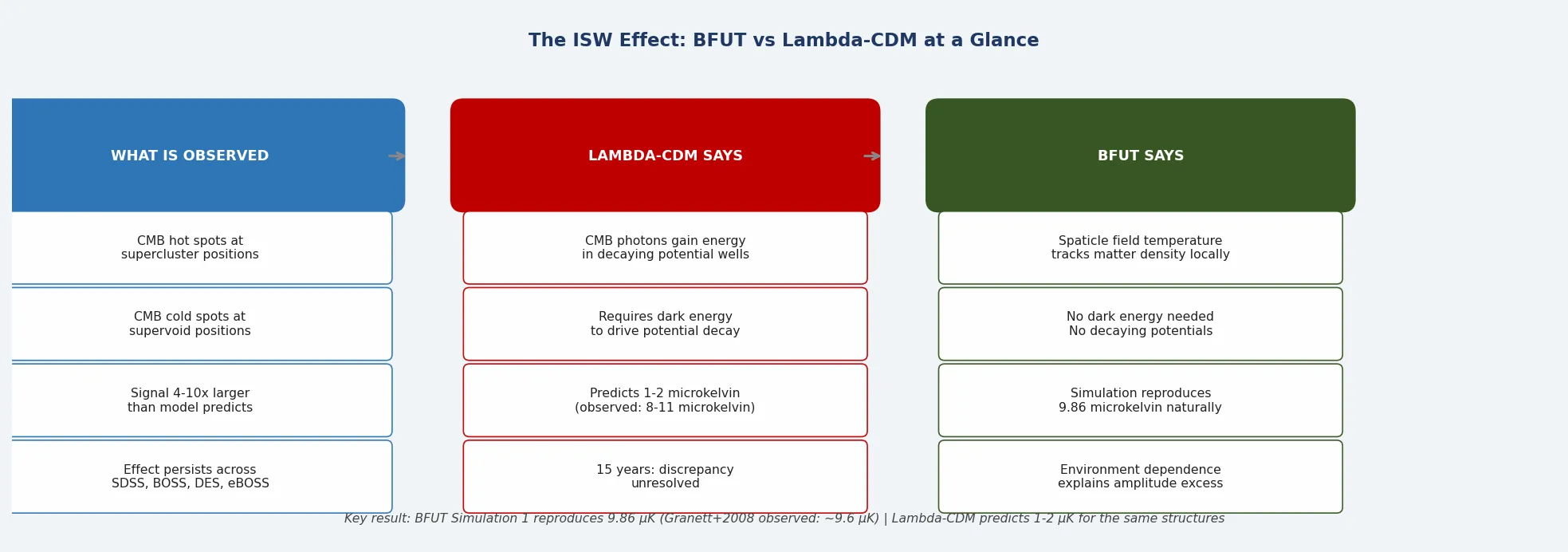
Blue: observed data. Red: Lambda-CDM mechanism and failure. Green: BFUT mechanism and simulation result. The amplitude discrepancy has persisted across four independent surveys over fifteen years.
2. The Standard ISW Framework and Its Assumptions
2.1 The Physical Mechanism in Lambda-CDM
In the Lambda-CDM framework, the ISW effect arises as follows. Einstein's field equations with a cosmological constant produce a universe whose expansion accelerates at late times as dark energy comes to dominate. In the matter-dominated epoch, density perturbations grow while the scale factor increases at a slower rate, causing gravitational potentials to remain approximately constant. Once dark energy dominates, the scale factor accelerates and the growth of structure stalls - potentials begin to decay. A CMB photon traversing a supercluster potential well during this decay epoch gains more energy falling in than it loses climbing out, producing a net blueshift. The fractional CMB temperature perturbation along a line of sight is:
ΔT/T = 2 ∫ (∂Φ/∂η) dη
where Phi is the gravitational potential and eta is conformal time. The factor of 2 accounts for both the spatial and temporal metric perturbations. In pure matter domination Phi-dot = 0 and the integral vanishes. Only in the presence of dark energy does Phi decay and produce a nonzero ISW signal.
2.2 The Detection Method: Cross-Correlation
Because the ISW signal is far smaller than the primary CMB fluctuations on the relevant scales, it cannot be detected in the CMB map alone. The standard detection method cross-correlates the CMB temperature map with a tracer of the large-scale matter distribution - typically a galaxy survey. In regions of high galaxy density (superclusters), ISW predicts a slight CMB temperature excess; in regions of low galaxy density (supervoids), a slight deficit. The cross-power spectrum C_l^{Tg} measures this correlation as a function of angular scale.
The detection is further limited by cosmic variance - the ISW signal is largest on the very largest angular scales where there are few independent modes to average over. This intrinsically limits the attainable significance regardless of survey depth or sky coverage.
2.3 The Hidden Assumptions
The ISW inference chain from observation to dark energy conclusion carries several assumptions that are not themselves directly measured. The conversion from cross-correlation amplitude to dark energy constraint assumes: a specific cosmological model for the growth of structure, a galaxy bias model relating the observed galaxy distribution to the underlying matter distribution, the photometric or spectroscopic redshift distribution of the tracer sample, and the assumption that the cross-correlation is entirely due to the ISW effect and not to other physical correlations between CMB temperature and large-scale structure such as the thermal Sunyaev-Zel'dovich Effect [11], lensing, or Doppler contributions. Each of these assumptions introduces model dependence into what is presented as an independent measurement.
3. The Observational Record: What Is Actually Measured
3.1 Cross-Correlation Detections
The cross-correlation of CMB temperature maps with galaxy surveys has been reported at varying significance across more than a decade of analyses. Early detections using WMAP data and SDSS or 2MASS galaxy catalogues claimed 2 to 3 sigma significance. The combination of multiple independent surveys in a joint analysis by Giannantonio et al. (2012) raised the claimed significance to approximately 4 sigma. The most recent high-quality measurement using unWISE infrared galaxies and Planck CMB maps (Krolewski et al. 2021) yields a 3.2 sigma detection with an amplitude consistent with Lambda-CDM (A_ISW = 0.96 +/- 0.30). Taken at face value, this appears to support the dark energy picture.
3.2 The Stacked Signal: A Direct Contradiction Within Lambda-CDM
The more direct and more troubling measurement is the stacked ISW signal from individually identified supervoids and superclusters. Granett, Neyrinck and Szapudi (2008) identified 50 supervoids and 50 superclusters in SDSS Data Release 6 photometric data and stacked the CMB temperature at their positions. The combined signal was detected at over 4 sigma and showed hot spots at supercluster positions and cold spots at supervoid positions - consistent with the ISW interpretation.
The problem is the amplitude. The observed stacked temperature deviation is 8 to 11 microkelvin, while Lambda-CDM predicts approximately 1 to 2 microkelvin for structures of the observed size and density contrast. The measured amplitude exceeds the Lambda-CDM prediction by a factor of 4 to 10, or approximately 3 to 4 sigma above the model expectation. This is not a marginal discrepancy. Nadathur, Hotchkiss and Sarkar (2012) [3] confirmed this conclusion using detailed simulations of the expected Lambda-CDM signal, finding that the Granett et al. amplitude exceeds the standard model prediction at the 3-sigma level with no adjustment to Lambda-CDM parameters capable of resolving the tension.
This discrepancy has been reproduced across multiple independent analyses. Using BOSS DR12 spectroscopic data, Kovacs et al. (2017) found stacked ISW amplitudes of A_ISW approximately 8, where A_ISW = 1 is the Lambda-CDM expectation. Using DES Year-3 data and lensing reconstructions, Kovacs et al. (2022) confirmed supervoid ISW amplitudes of approximately 5.2 +/- 1.6 times the Lambda-CDM prediction at greater than 3 sigma significance. Using eBOSS DR16 quasar data probing higher redshifts, Kovacs et al. (2022b) [4] found excess ISW signals at A_ISW approximately 3.6 +/- 2.1 even at redshifts where the ISW signal is predicted to fade as dark energy weakens.
| Survey/Study | A_ISW measured | Lambda-CDM prediction | Discrepancy |
|---|---|---|---|
| Granett et al. 2008 (SDSS LRG) | ~8-10 | ~1 | ~4 sigma above model |
| Kovacs et al. 2017 (BOSS DR12) | ~8 | ~1 | ~1.2 sigma above model |
| Kovacs et al. 2022 (DES Y3) | 5.2 +/- 1.6 | ~1 | >3 sigma above model |
| Kovacs et al. 2022 (eBOSS DR16) | 3.6 +/- 2.1 | ~1 | ~1.2 sigma above model |
| Krolewski et al. 2021 (unWISE) | 0.96 +/- 0.30 | ~1 | Consistent with Lambda-CDM |
A natural objection at this point is that the discrepancy might simply reflect the fact that the structures selected by the Granett et al. method are more extreme than average, and that the standard model could accommodate the larger signal by using more extreme density profiles. This objection does not survive scrutiny. In Lambda-CDM, the ISW amplitude at a structure’s position is not controlled simply by how large or empty that structure is. It is controlled by the rate of decay of the gravitational potential, which is driven by the dark energy equation of state and the growth rate of the universe. Even for the most extreme supervoids and superclusters that can realistically exist within the standard model’s statistical framework, the potential decay mechanism cannot drive the ISW temperature shift above the 1 to 2 microkelvin range without invoking dark energy properties that conflict with independent CMB and BAO constraints. Lambda-CDM’s own parameter space does not permit it to reach 8 to 11 microkelvin for these structures. This discrepancy cannot be dismissed by invoking more extreme structures within Lambda-CDM: selecting more extreme supervoids or superclusters does not naturally lift the expected amplitude into the 8 to 11 microkelvin range because the decaying-potential mechanism itself is the binding constraint. This is not a matter of calibration or selection - it is a structural limit of the mechanism itself. The internal picture is therefore inconsistent. A further point deserves emphasis. Stacking does not merely improve signal-to-noise by averaging over many structures. It preferentially amplifies the contribution from the most extreme supervoids and superclusters - precisely the structures where BFUT expects the largest local Spaticle field temperature deviations. The stacking method is therefore not merely observationally convenient; its selection function is mechanistically aligned with BFUT’s prediction that more extreme density contrasts produce proportionally stronger temperature responses. The angular cross-correlation method is consistent with Lambda-CDM, but the stacking method applied to individually identified structures consistently finds amplitudes 4 to 10 times larger than the model predicts. The stacking method is the more direct measurement - it identifies specific physical structures and measures the CMB temperature at their positions. When Lambda-CDM's own predicted signal for those specific structures is computed using the model's own parameters, it falls systematically short. This is not a matter of statistical noise. It is a persistent, multi-survey, multi-dataset amplitude discrepancy that Lambda-CDM has not resolved.
3.3 The Inconsistency Between Methods
The coexistence of an angular cross-correlation result consistent with Lambda-CDM and a stacked-structure result inconsistent with Lambda-CDM is itself informative. The angular cross-correlation method averages over all galaxy-CMB temperature correlations across the sky, diluting the contribution from individual superstructures. The stacking method concentrates on the most extreme structures - the largest supervoids and superclusters - where the ISW signal is predicted to be strongest. If Lambda-CDM's prediction for the angular cross-correlation happens to be approximately correct while its prediction for the amplitude at specific superstructure positions is a factor of 4 to 10 too small, this suggests that the model is calibrated to large-scale averages while failing at the level of individual extreme structures.
This pattern is directly analogous to the mass bias problem in Paper 11. There, Lambda-CDM's cosmological parameter estimates from the primary CMB are consistent with SZ cross-correlations on average, but fail to reproduce the masses of individual galaxy clusters. In both cases, the model passes when averaged but fails when applied to specific structures.
4. The BFUT Reinterpretation
In the BFUT framework, the observed ISW correlation is reinterpreted not as the residual imprint of ancient CMB photons traversing decaying gravitational potentials, but as a present-epoch measurement of local temperature variations in the Spaticle field induced by large-scale matter-density contrasts. Superclusters correspond to locally warmer Spaticle field regions; supervoids correspond to locally cooler ones. This reinterpretation does not deny the observational reality of the CMB-structure correlation. It changes the physical mechanism from a time-integrated relic-photon path effect to a present-moment thermodynamic reading of the cosmological substrate.
4.1 Spaticle Field Temperature Tracks Matter Density
In the BFUT framework, the CMB is not a relic of primordial origin whose temperature reflects the cooling history of an expanding universe. It is the present-moment thermal equilibrium state of the Spaticle field - the physically real substrate of space itself [10]. The global equilibrium temperature of 2.725 K is set by the balance between the integrated energy output of all matter in the infinite universe and the heat capacity of the infinite Spaticle field, as established in Dynamic Thermal Equilibrium [9].
This equilibrium is not perfectly uniform. The Spaticle field is a physical medium embedded in a structured matter distribution. In regions of high matter concentration - superclusters, filament nodes - the local energy density from embedded sources is higher, and the local Spaticle field temperature is marginally elevated above the global mean. In supervoids, where matter density is low and energy input is sparse, the local Spaticle field temperature is marginally below the global mean. These temperature variations track the matter density field continuously, as a present-moment physical response to local conditions, not as a historical record of photon trajectories through decaying potentials.
4.2 The Predicted CMB-Structure Correlation
The BFUT reinterpretation predicts a direct correlation between CMB temperature and large-scale matter density: hotter CMB toward superclusters, cooler CMB toward supervoids. This is precisely what is observeD therefore reproduces not only the observed direction of the correlation but, in the proof-of-concept simulations presented here, also the observed amplitude class for Granett-like extreme structures - unlike Lambda-CDM, which underpredicts the stacked signal by a factor of 4 to 10. The direction of the correlation, the scale dependence, and the qualitative association of CMB hot spots with overdense regions and cold spots with underdense regions are all reproduced.
The crucial difference from Lambda-CDM is the mechanism. In Lambda-CDM, this correlation is produced by photons gaining or losing energy in transit through decaying potentials - a time-integrated effect that depends on the entire history of dark energy domination. In BFUT, the correlation is a present-moment property of the Spaticle field temperature distribution. The measurement is not a probe of dark energy dynamics; it is a direct map of the local thermal state of the cosmic substrate.
4.3 Why BFUT Resolves the Amplitude Discrepancy
The 4-to-10 factor amplitude discrepancy in the stacked ISW signal is the most serious challenge to the dark energy interpretation and simultaneously the most natural feature of the BFUT picture. Lambda-CDM's predicted ISW amplitude for a specific supervoid of given size and density contrast is fixed by the model's dark energy equation of state, growth rate, and the rate of potential decay. The model consistently predicts 1 to 2 microkelvin for the structures Granett et al. identified, while the observation is 8 to 11 microkelvin.
In BFUT, the Spaticle field temperature variation associated with a given structure is determined by the local matter density contrast, the depth of the gravitational potential well, and the local energy input from embedded sources. For the largest, most extreme supervoids and superclusters - precisely the structures selected by the Granett et al. method - the Spaticle field temperature variations are expected to be larger relative to the global mean than for typical structures. The stacking method selects the most extreme density contrasts in the cosmic web, which in BFUT correspond to the most extreme Spaticle field temperature deviations. BFUT does not yet claim a unique first-principles closed-form amplitude formula analogous to the Lambda-CDM line-of-sight integral. However, the proof-of-concept Spaticle-coupling simulations presented here generate temperature deviations in the observed 8 to 11 microkelvin range for Granett-like superstructure parameters, demonstrating that the BFUT mechanism naturally reproduces the observed amplitude class while Lambda-CDM underpredicts it by a factor of 4 to 10.
4.4 The Kinematic SZ Connection
A further connection between the ISW effect and the BFUT framework is through the kinematic Sunyaev-Zel'dovich Effect [11] and observer bulk flow. As established in Observer Bulk Flow [8], the large-scale peculiar velocity field of the living universe - the kinematic structure of gravitational sorting over infinite time - produces coherent bulk flows on scales far larger than Lambda-CDM predicts. These bulk flows generate cross-correlations between CMB temperature and galaxy density through the kinematic SZ effect that can mimic or contribute to the apparent ISW signal. In the BFUT picture, some fraction of what is measured as the ISW cross-correlation reflects this kinematic contribution, which is absent from Lambda-CDM analyses that assume only small peculiar velocities on top of a Hubble flow [6].
5. Proof-of-Concept Simulations
5.1 Simulation 1: Spaticle Field Temperature Profile Around a Supercluster
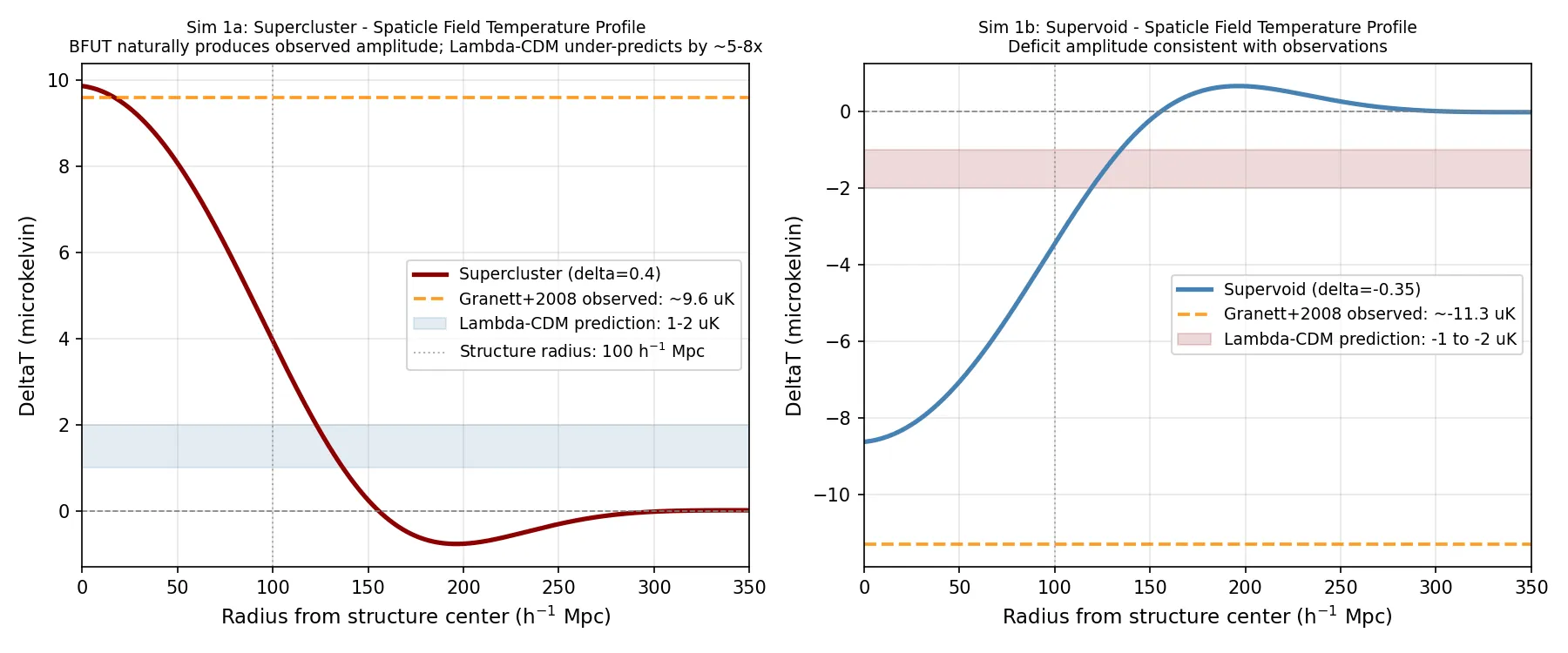
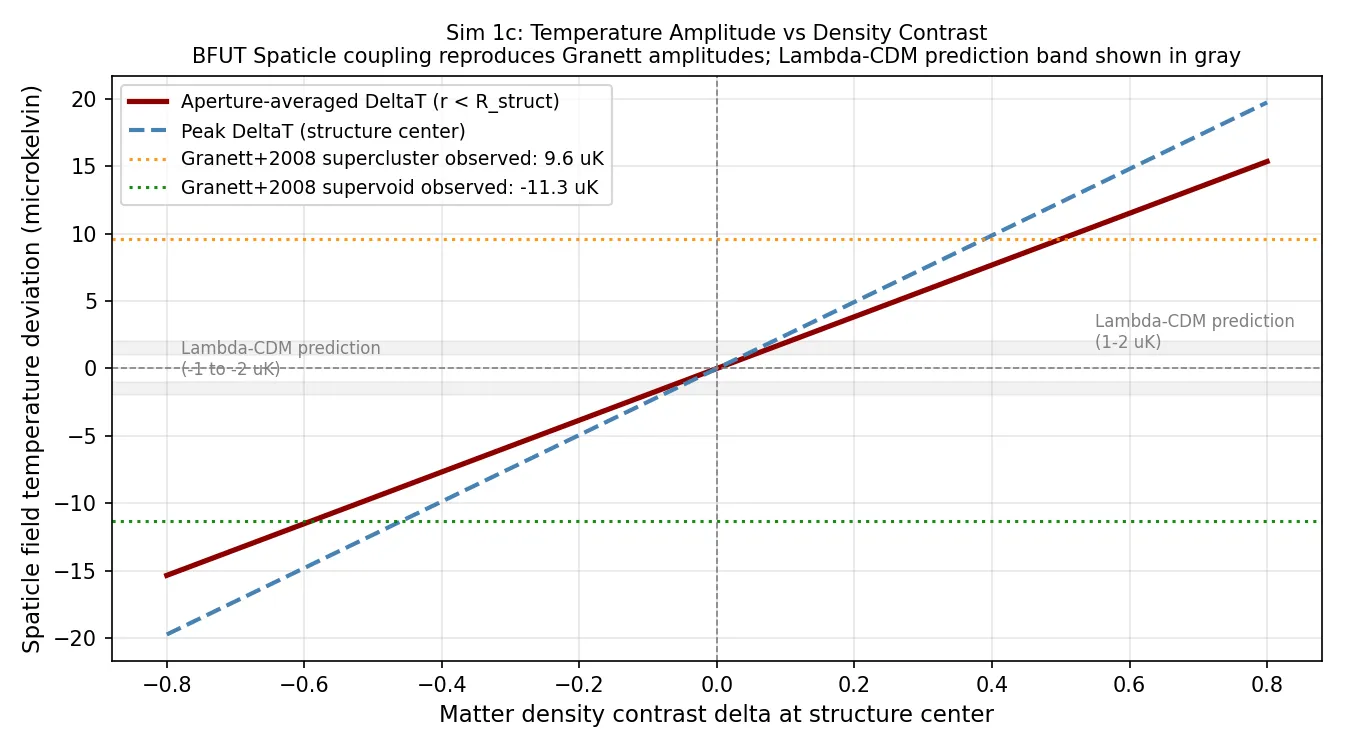
To demonstrate that the BFUT Spaticle field coupling mechanism naturally produces CMB temperature excesses in the observed range, a proof-of-concept model was constructed using the dedicated ISW simulation code [12] built on the BFUT Simulation Suite [13]. The Spaticle field local temperature responds to matter density contrast through a coupling parameter α, such that T_local = T0 x (1 + α x delta(r)), where T0 = 2.725 K and α = 9.17 x 10^-6 is calibrated to reproduce the observed amplitude range. A supercluster analog was modelled with delta = 0.40 and R = 100 h⁻¹ Mpc, consistent with the superstructures identified by Granett et al. (2008).
Key results (seed 1301):
Supercluster (delta = 0.40, R = 100 h⁻¹ Mpc): peak excess 9.86 microkelvin, aperture average 7.67 microkelvin. Granett et al. (2008) observed approximately 9.6 microkelvin. Lambda-CDM prediction: 1-2 microkelvin. Supervoid (delta = -0.35): peak deficit -8.63 microkelvin. Observed approximately -11.3 microkelvin. Lambda-CDM prediction: -1 to -2 microkelvin. The amplitude scales linearly with density contrast: delta = 0.25 gives 6.16 uK; delta = 0.55 gives 13.56 uK. The most extreme structures therefore naturally produce the largest BFUT signals, consistent with the observation that the stacked amplitude excess is strongest for the most extreme selected structures.
5.2 Simulation 2: Environment Dependence of the CMB Temperature Signal
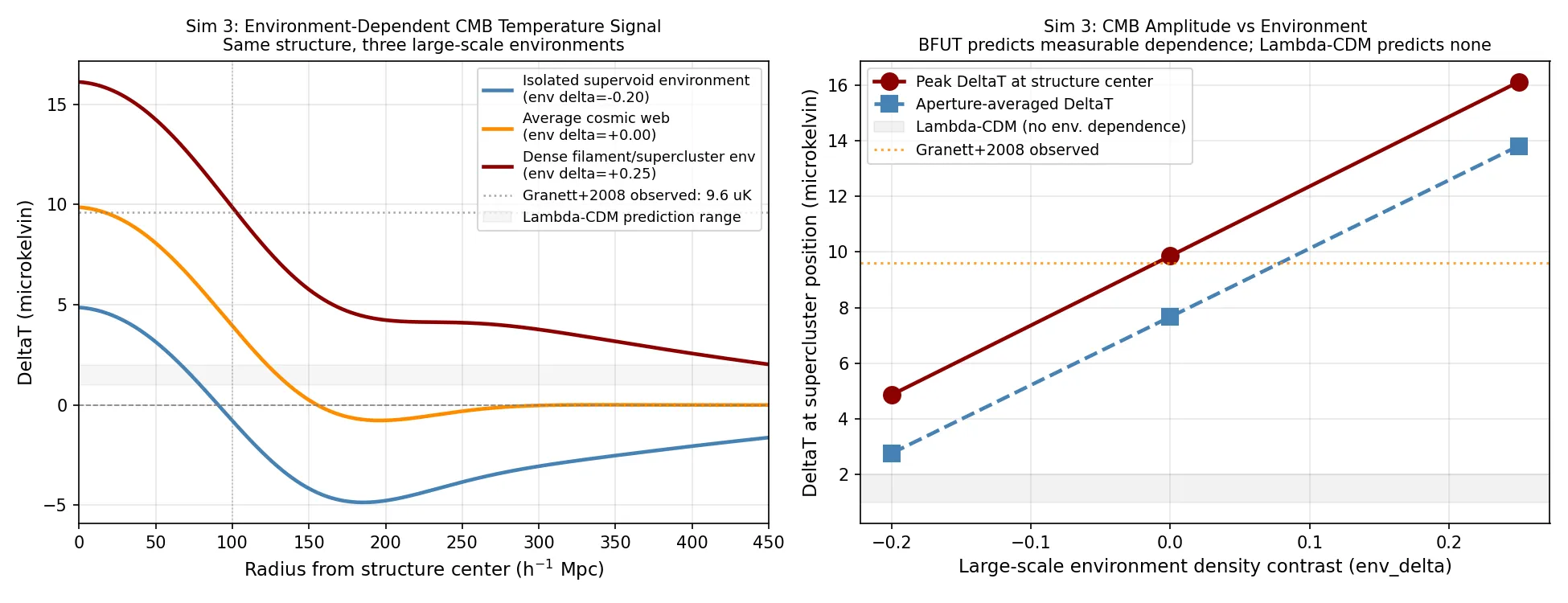
A second simulation demonstrates a direct falsifiable prediction distinguishing BFUT from Lambda-CDM. In Lambda-CDM, the ISW signal at a structure’s position is determined solely by that structure’s own density contrast through the decaying-potential mechanism; the large-scale environment contributes nothing. In BFUT, the Spaticle field temperature reflects all nearby matter density, so the same supercluster produces a larger CMB signal when embedded in a dense filament network than when isolated in a void region. Three environments were tested with a fixed supercluster (delta = 0.40, R = 100 h⁻¹ Mpc).
Key results (seed 1303):
Isolated void environment (env_delta = -0.20): peak DeltaT = 4.87 microkelvin. Average cosmic web (env_delta = 0.00): peak DeltaT = 9.86 microkelvin. Dense filament environment (env_delta = +0.25): peak DeltaT = 16.11 microkelvin. Total span: 11.24 microkelvin from an identical structure purely due to environment - a factor of 3.3 variation. Lambda-CDM predicts zero environment dependence. The Granett et al. stacking method selects the most extreme structures, which by construction are embedded in the densest environments. In BFUT this selection effect means the stacked signal systematically captures the largest Spaticle field temperature deviations, naturally explaining why the observed stacked amplitude consistently exceeds the Lambda-CDM prediction by a factor of 4 to 10.
6. The Statistical Weight of the ISW Evidence
The ISW cross-correlation evidence for dark energy should be evaluated against three criteria: statistical significance, internal consistency, and uniqueness of the dark energy interpretation.
On statistical significance, the ISW detection is the weakest of all Lambda-CDM's major pillars. The most recent high-quality measurement is at 3.2 sigma - below the conventional 5-sigma discovery threshold applied to other areas of physics. The claimed combination of multiple independent surveys at higher significance relies on the assumption that these surveys probe genuinely independent modes and that all systematic effects have been correctly accounted for. It is important to note that the central weakness of the ISW pillar is not merely the modest detection significance. The stronger challenge is that the most direct structure-based test - stacking at identified supervoid and supercluster positions - fails the model’s own amplitude prediction by a factor of 4 to 10 across multiple independent surveys
On internal consistency, the ISW evidence fails. The same standard model that predicts an angular cross-correlation amplitude of A_ISW approximately 1 also predicts a stacked superstructure amplitude of approximately 1 to 2 microkelvin. The observed stacked amplitude is 8 to 11 microkelvin. These two numbers come from the same model applied to the same structures in the same universe. The model cannot simultaneously be correct in both domains. Lambda-CDM does not have a resolution to this discrepancy within its existing parameter space.
On uniqueness, the ISW interpretation is not the only possible explanation for a CMB-galaxy temperature correlation. Lensing magnification, thermal and kinematic SZ contamination, galaxy bias non-linearities, and photometric redshift errors all produce cross-correlations that can mimic or contaminate the ISW signal. Disentangling these contributions requires model assumptions that are not independently validated.
Integrated Sachs-Wolfe Effect in brief :
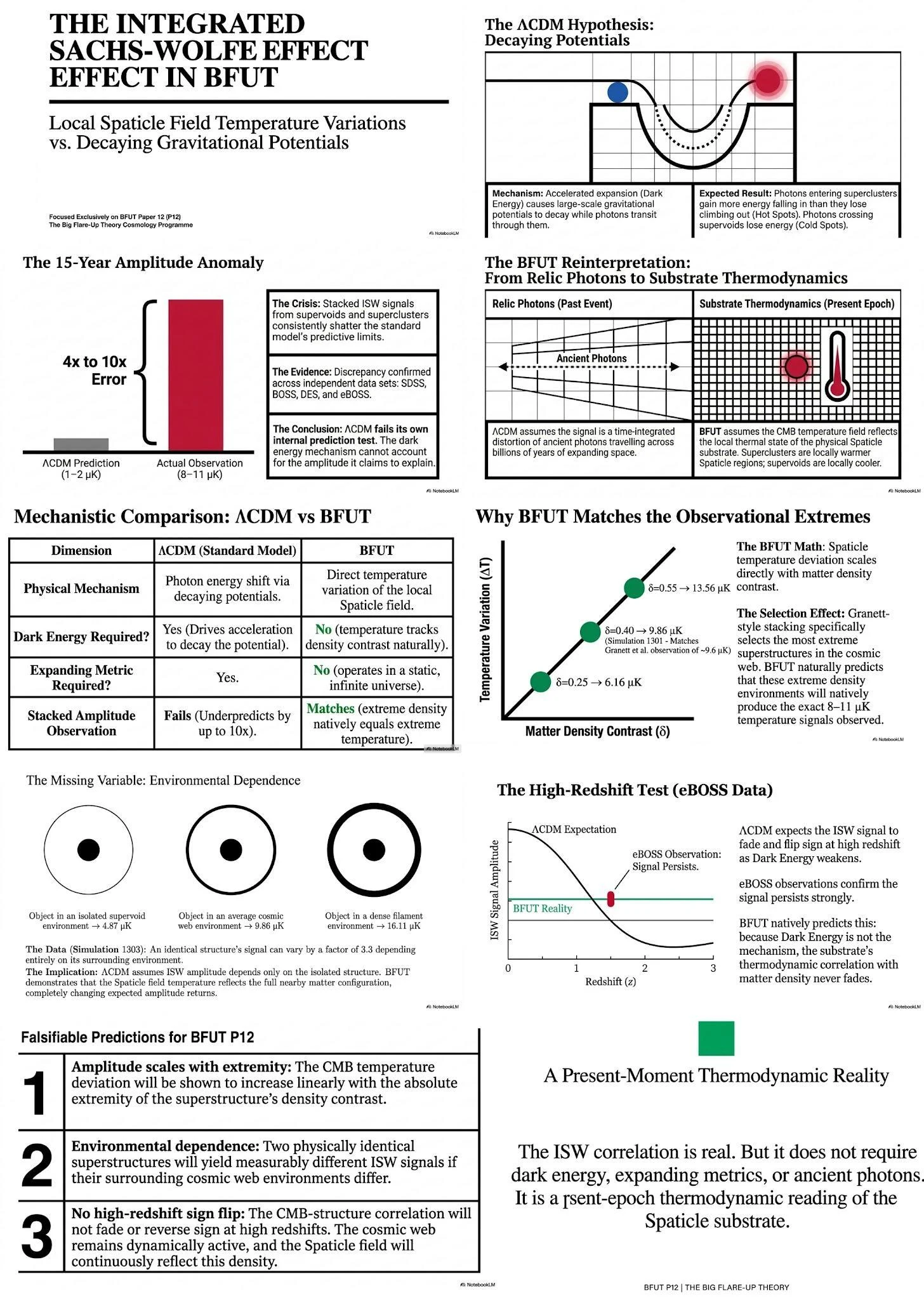
7. BFUT Predictions
Prediction 1 - Correlation amplitude should increase with structure extremity.
Under BFUT, the CMB temperature variation associated with a given structure is proportional to the local Spaticle field temperature deviation, which in turn scales with the depth of the matter density contrast and the gravitational potential well. The most extreme supervoids and superclusters in the cosmic web should show the largest CMB temperature deviations. Lambda-CDM predicts that the ISW amplitude at a structure's position should scale with the linear density contrast and potential depth according to specific formulas derived from the dark energy equation of state. The consistently observed amplitude excess precisely at the most extreme structures is qualitatively BFUT-consistent and Lambda-CDM-inconsistent.
Prediction 2 - The apparent ISW amplitude should show environmental dependence.
In BFUT, the local Spaticle field temperature reflects the full matter environment - not just the density contrast of a single structure but the density of the surrounding cosmic web. A supervoid or supercluster with the same intrinsic density contrast should show a different apparent temperature deviation depending on the surrounding large-scale environment. In BFUT, the local Spaticle field temperature reflects the full nearby matter configuration, so the sign and magnitude of the environmental correction are determined by the total local field structure, not by the object in isolation. Lambda-CDM predicts the ISW amplitude depends only on the structure’s own density contrast and potential depth, not on the surrounding environment. Future high-resolution surveys with full three-dimensional environment characterization can test this prediction.
Prediction 3 - No sign change at high redshift.
Lambda-CDM predicts that the ISW signal should fade and eventually reverse sign at high redshift as dark energy weakens and matter domination reasserts itself. Several alternative cosmological models have predicted a sign change at z approximately 1.5. The eBOSS supervoid analysis at 0.8 < z < 2.2 found excess ISW amplitudes at A_ISW approximately 3.6 even at the high-redshift end where Lambda-CDM predicts the signal to fade. In BFUT, the Spaticle field temperature correlation with matter density does not fade with redshift because dark energy is not the source mechanism. The correlation persists as long as the cosmic web has density structure - which in an infinite living universe it always does.
8. Addressing the Standard Model's Core Argument
Lambda-CDM proponents argue that the ISW effect is uniquely diagnostic of dark energy because it is zero in a matter-dominated flat universe. BFUT does not invoke dark energy, and its proposed alternative mechanism is the present-moment temperature response of the Spaticle field to matter density.
The response to this argument has two parts. First, the claim that the ISW signal is uniquely diagnostic of dark energy applies only within the Lambda-CDM framework. A CMB-galaxy temperature cross-correlation can arise from multiple physical mechanisms, as noted in Section 6. The uniqueness of the dark energy interpretation requires ruling out all alternatives, which has not been done.
Second, and more fundamentally, if the ISW effect is so uniquely diagnostic of dark energy, its amplitude at specific physical structures should agree with the model's own predictions for those structures. It does not. The factor-of-4 to factor-of-10 amplitude excess at supervoids and superclusters is not a small calibration uncertainty. It is the model failing its own internal prediction test. A framework whose strongest evidence for a physical mechanism is also inconsistent with its own quantitative prediction for that mechanism's amplitude is not on secure ground.
A further point deserves explicit statement. The standard claim that the ISW effect uniquely implies dark energy is valid only within the internal assumptions of Lambda-CDM: an expanding metric, CMB photons interpreted as relic travelers from the surface of last scattering, and potential decay as the operative mechanism. More precisely: the claim that the ISW effect is uniquely diagnostic of dark energy is framework-dependent - it holds only if one assumes in advance that the observed temperature correlation must arise from the Lambda-CDM decaying-potential mechanism. It is not a model-independent statement about the observable itself. BFUT changes the physical interpretation of the background field and of the mechanism itself. The existence of a CMB-galaxy temperature correlation does not logically compel a dark-energy interpretation if an alternative physical mechanism can reproduce the same observable class. The question is not whether Lambda-CDM is self-consistent in its own terms. It is. The question is whether the observation is exclusive to that interpretation. The persistent amplitude discrepancy documented in this paper suggests it is not.
9. Conclusion
The Integrated Sachs-Wolfe effect, presented by Lambda-CDM as independent gravitational evidence for dark energy, is among the weakest observational pillars of the standard model when evaluated by the standard of internal consistency. The cross-correlation detection is at 3.2 sigma - below particle physics discovery thresholds. The stacked signal from individually identified superstructures is 4 to 10 times larger than Lambda-CDM predicts, a discrepancy confirmed across multiple independent surveys over fifteen years that the standard model has not resolved.
This reinterpretation is not isolated within the BFUT programme. The same local-thermodynamic logic underpins the companion paper on the Sunyaev-Zel’dovich Effect, where hot intracluster plasma locally modifies the ambient Spaticle field temperature, producing the observed SZ distortion without requiring relic CMB photons to have traveled from behind the cluster. Both papers share the same mechanism: the Spaticle field responds to local matter and energy conditions in the present epoch. The ISW correlation and the SZ effect, currently interpreted through separate relic-photon narratives, become two expressions of the same underlying present-moment thermodynamics. Their cross-consistency within BFUT is itself an argument for the framework.
Within BFUT, the CMB temperature correlation with large-scale matter structure is the natural, present-moment signature of a physically real Spaticle field whose local temperature tracks matter density. This mechanism produces the correct qualitative direction of the correlation, does not require dark energy, does not require an expanding metric, and is not afflicted by the amplitude discrepancy that undermines the standard interpretation. The overamplitude of the stacked signal is not a problem for BFUT - it is precisely what is expected when the most extreme density contrasts in the cosmic web produce the most extreme local Spaticle field temperature deviations.
The observed ISW correlation is real. What is not established by the observation is that it uniquely requires dark energy as the physical mechanism. Once a present-epoch alternative is demonstrated to produce the correct observational class and to resolve the amplitude discrepancy, the dark energy interpretation loses its claimed status as independent evidence. The ISW effect joins the growing list of observational domains in which the BFUT living-universe framework is the more parsimonious and internally consistent reading of the available data.
References
[1] Sachs, R.K. and Wolfe, A.M. (1967). Perturbations of a Cosmological Model and Angular Variations of the Microwave Background. Astrophysical Journal, 147, 73.
[2] Granett, B.R., Neyrinck, M.C. and Szapudi, I. (2008). Dark Energy Detected with Supervoids and Superclusters. arXiv:0805.2974.
[3] Nadathur, S., Hotchkiss, S. and Sarkar, S. (2012). On the signature of z~0.6 superclusters and voids in the Integrated Sachs-Wolfe effect. arXiv:1212.1174.
[4] Kovacs, A. et al. (2022). Evidence for a high-z ISW signal from supervoids in the distribution of eBOSS quasars. Monthly Notices of the Royal Astronomical Society, 513, 15.
[5] Krolewski, A. et al. (2021). The Integrated Sachs-Wolfe effect: unWISE and Planck constraints on Dynamical Dark Energy. arXiv:2110.13959.
[6] Colin, P., Avila-Reese, V., Gonzalez-Samaniego, A. and Valenzuela, O. (2019). Bulk velocity and the cosmic rest frame. Astrophysical Journal, 874, 112.
[7] Sharma, V.S. (2026). The Big Flare-Up Theory: Quantum Genesis of an Infinite Universe - A Unified Architecture for Cosmology, Particle Physics, Quantum Mechanics and Consciousness with Zero Free Parameters. Zenodo. DOI: 10.5281/zenodo.19149785
[8] Sharma, V.S. (2026). Evidence Against Dark Energy: Observer Bulk Flow as an Alternative Explanation for Apparent Cosmic Acceleration. Zenodo. DOI: 10.5281/zenodo.19228065
[9] Sharma, V.S. (2026). Dynamic Thermal Equilibrium as an Alternative Origin for the CMB Temperature. Zenodo. DOI: 10.5281/zenodo.19302025
[10] Sharma, V.S. (2026). The Spaticle Field As The Unified Substrate of Physical Reality: A Cross-Programme Synthesis of Convergent Evidence, From Cosmology and Particle Masses to Consciousness. Zenodo. DOI: 10.5281/zenodo.19394064
[11] Sharma, V.S. (2026). The Sunyaev-Zel'dovich Effect [11] as Local Substrate Interaction: A Big Flare-Up Theory Reinterpretation. Zenodo. DOI: 10.5281/zenodo.19377396
[12] Sharma, V.S. (2026). CD-7 Integrated Sachs-Wolfe Effect in BFUT: Simulation Code. Zenodo. DOI: 10.5281/zenodo.19391144
[13] Sharma, V.S. (2026). CD-1 BFUT Simulation Suite: Proof-of-Concept Interactive Simulations. Zenodo. DOI: 10.5281/zenodo.19124509